

Views: 0 Author: Site Editor Publish Time: 2026-03-04 Origin: Site


A single belt failure can shut down crushing, processing, and shipping in minutes, turning a small issue into a major production loss. Is your Mining Conveyor belt truly engineered for your mine’s real loads, abrasive ore, and harsh environment, or was it selected based on habit and price alone? Many costly breakdowns happen not because the belt was poor quality, but because it was mismatched to actual operating conditions.
In this article, you will learn a clear, step-by-step framework for how to choose the right conveyor belt for mining operations, from defining duty profile and analyzing material behavior to validating pulley limits and comparing total cost of ownership. We will highlight practical decision points, common failure risks, and engineering checks that help reduce downtime, improve safety compliance, and maximize belt service life.
The first and most overlooked step in selecting a Mining Conveyor belt is clearly defining how the conveyor will operate in real conditions rather than relying on historical assumptions or nominal design capacity. Production targets often increase over time, yet belt specifications remain unchanged, creating hidden stress that eventually surfaces as premature wear, splice failure, or excessive elongation. A comprehensive duty profile should document target throughput in tons per hour, peak surge loads, belt speed, operating hours per day, seasonal variations, and expected service life. Including restart frequency is particularly important because high-torque startup conditions can impose greater stress than steady-state operation.
Equally critical is a realistic evaluation of the conveyed material. Ore characteristics directly influence belt wear patterns and failure mechanisms, and even within the same mineral category, differences in silica content, moisture level, and fragmentation method can dramatically alter belt performance. Abrasiveness determines cover wear rate, while lump size and angularity influence impact severity at transfer points. High fines content may increase friction and dust accumulation, whereas sticky clay materials can cause carryback that contaminates return idlers and accelerates tracking problems. Elevated material temperature near crushers or kilns may degrade standard rubber compounds over time (validation required). By documenting these factors in measurable terms, engineering teams can translate material behavior into specific cover grades, thickness requirements, and carcass strength targets.
When duty profile and material data are analyzed together, a clearer picture emerges of whether abrasion resistance, impact absorption, tensile strength, or chemical tolerance should be prioritized. This step prevents the common mistake of selecting belts based solely on tensile rating while ignoring cover durability or environmental compatibility.
After defining operating conditions and material behavior, the next stage involves aligning belt construction with both environmental exposure and the physical limitations of the existing Mining Conveyor structure. Surface conveyors experience ultraviolet radiation, rain, temperature cycling, and ozone exposure, all of which can degrade rubber compounds over time. In contrast, underground conveyors operate in confined spaces where humidity, heat accumulation, and fire safety regulations become dominant design factors. A belt compound suitable for outdoor surface use may not meet underground flame-resistance standards, and failing to account for this difference can create compliance and safety risks.
Beyond environmental exposure, mechanical compatibility must be verified carefully. Every belt construction has a minimum pulley diameter requirement that ensures acceptable flexing without inducing premature carcass fatigue. Installing a stiffer or thicker belt on pulleys designed for a more flexible construction can lead to cracking near splice zones or edge delamination. Transition distances between flat and troughed sections must also accommodate the selected belt’s stiffness to avoid excessive edge stress. Inadequate troughing support or improper idler spacing can result in sagging, spillage, and accelerated cover wear.
The following table summarizes how environmental and mechanical factors influence belt specification decisions:
Factor | Risk if Ignored | Belt Design Response |
UV and weather exposure | Surface cracking and premature aging | UV-resistant compounds |
Underground fire risk | Flame spread and compliance violations | Fire-resistant certified belts |
High material temperature | Rubber hardening and cracking | Heat-resistant cover compounds |
Small pulley diameter | Carcass fatigue and splice stress | Flexible carcass or pulley redesign |
Long conveyor length | Excessive elongation and take-up limits | Steel-cord or high-tensile fabric construction |
By evaluating these constraints before requesting supplier quotations, mining operations avoid costly redesigns or compatibility conflicts during installation.
Once operating conditions and system constraints are clarified, the focus shifts to selecting the belt type that best addresses the dominant failure risk within the Mining Conveyor system. Instead of defaulting to the same belt used historically, operations teams should examine maintenance records to identify recurring problems such as longitudinal tears near crushers, excessive stretch on long runs, or rapid top-cover wear under abrasive ore.
Multi-ply fabric belts are widely used in mining because their layered construction provides good shock absorption and flexibility, making them suitable for moderate-length conveyors with variable loading conditions. They often perform well in underground settings where access is limited and impact resistance is valuable. However, for conveyors exposed to severe impact or repeated tear incidents, straight-warp constructions offer enhanced tear resistance by integrating longitudinal and transverse reinforcement layers that better resist propagation of cuts.
Steel-cord belts are particularly effective in long-distance Mining Conveyor systems where high tensile strength and minimal elongation are required. Their low stretch characteristics reduce take-up travel and improve load stability over extended spans, but they demand precise splicing and alignment practices. Specialty belts, including heat-resistant or fire-resistant variants, are essential when environmental or safety conditions exceed the tolerance of standard rubber compounds.
The table below provides a simplified comparison to support decision-making:
Belt Type | Ideal Application | Key Strength | Operational Consideration |
Multi-ply Fabric | General duty, moderate impact | Flexibility and shock absorption | Higher elongation |
Straight-Warp | High impact, tear-prone loading zones | Strong tear resistance | Moderate cost increase |
Steel-Cord | Long-distance, high-tension conveyors | Low stretch, high tensile strength | Requires disciplined splicing |
Specialty | Heat, fire, chemical exposure environments | Environment-specific durability | Higher upfront investment |
Selecting the belt type that directly mitigates the most common failure mode often delivers greater long-term value than choosing the highest tensile rating available.
In many procurement processes, belt selection narrows quickly to price comparisons, yet the purchase price of a Mining Conveyor belt typically represents only a fraction of its lifecycle cost. Downtime resulting from premature failure can exceed the belt’s material cost within hours in high-throughput operations. Therefore, evaluating total cost of ownership (TCO) provides a more realistic decision framework.
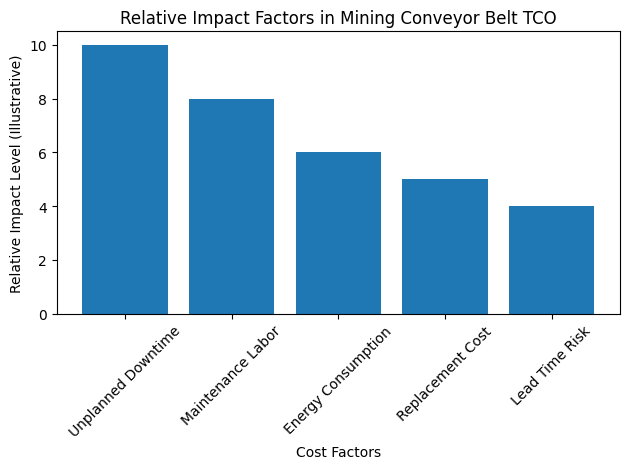
TCO analysis should incorporate projected service life under documented operating conditions, frequency and duration of maintenance interventions, splice longevity, energy consumption differences due to rolling resistance, and the risk associated with long lead times. For example, a higher-grade abrasion-resistant belt may cost more initially but extend service life by several months (validation required), reducing shutdown frequency and labor expenses. Similarly, selecting a lower-stretch construction may stabilize tracking and reduce idler replacement costs over time.
When TCO factors are quantified and discussed transparently among operations, maintenance, and finance teams, belt selection shifts from a short-term cost-saving exercise to a long-term reliability strategy that supports production stability.
Even the most carefully selected Mining Conveyor belt can fail prematurely if installation and maintenance practices are inadequate. Alignment errors during installation often lead to chronic mistracking, which accelerates edge wear and shortens service life. Proper tensioning, accurate pulley alignment, centered loading at transfer points, and verification of cleaner effectiveness during commissioning are essential steps that directly influence belt performance.
Splicing strategy also affects long-term reliability. Mechanical fasteners allow rapid installation and repair in remote sites where vulcanizing equipment may be limited, while vulcanized splices provide superior strength and durability for high-tension or long-distance conveyors. The choice should align with operational constraints, shutdown windows, and in-house technical capability.
A structured maintenance program further protects the investment. Regular inspections of top-cover wear, splice integrity, idler rotation, pulley lagging condition, and tracking patterns help detect early warning signs before catastrophic failure occurs. Monitoring motor power consumption trends may reveal increasing friction or misalignment that signals emerging issues (validation required). When repeated failures occur in the same location, a broader system audit should be conducted to examine chute alignment, impact bed design, or structural deflection rather than simply replacing the belt again.
Choosing the right conveyor belt for mining operations requires a disciplined process that integrates duty profile analysis, material characteristics, environmental conditions, mechanical validation, belt type comparison, and total cost evaluation. The optimal Mining Conveyor belt is not simply the strongest or cheapest option, but the one engineered for your mine’s real operating conditions, safety standards, and long-term production goals.
At Hebei Dizhuo Rubber & Plastic Products Co., Ltd, we combine technical expertise with reliable manufacturing to deliver customized Mining Conveyor belt solutions that match your exact requirements. Contact us today to receive professional guidance and a tailored quotation for your mining project.
A: Define load, ore type, environment, and pulley limits. Then match belt construction to real risks.
A: Most failures come from mismatch with abrasion, impact, or improper pulley and transition design.
A: Steel-cord belts fit long distances due to low stretch and high tensile strength.
A: Not always. Lower price may mean shorter life and higher downtime cost.
A: Ensure correct installation, proper tension, good loading design, and routine inspection.


