

Views: 0 Author: Site Editor Publish Time: 2026-07-13 Origin: Site


Conveyor belt misalignment remains a persistent operational headache on the plant floor. Maintenance teams often refer to it as the millwright's nightmare. A belt that constantly drifts laterally leads to severe edge wear, excessive material spillage, and costly unplanned downtime. Technicians frequently misdiagnose these symptoms as an untrackable belt. They waste hours adjusting take-up screws, over-tightening end rollers, and chasing the belt back and forth across the structure. Traditional tracking adjustments rely heavily on standard bare steel rollers and constant manual tensioning. These conventional methods fail rapidly under heavy lateral forces, uneven loading conditions, or high moisture environments. Over-tensioning to force alignment ultimately causes permanent belt stretch and premature splice failure.
Operations require a precision-engineered mechanical solution rather than endless manual tweaks. Implementing Polyurethane V Rollers forces positive alignment by combining the physical geometry of a V-profile with the high-friction, wear-resistant properties of cast urethane. This mechanical approach eliminates the guesswork associated with friction-dependent crowning. It ensures the belt stays centered, reducing edge damage and keeping bulk materials on the belt where they belong.
Belt wander rarely stems from a single isolated defect. Off-center loading pushes the belt laterally as the weight distribution forces the belt toward the lighter side. Structural frame skew forces the belt to climb toward the misaligned side, acting like a steering mechanism. Debris buildup on pulleys alters their effective diameter, creating uneven tension across the belt width. The degradation of standard tracking components further exacerbates these problems. When idlers seize or bearings fail, the resulting drag pulls the belt off its intended path. Identifying these root causes requires a thorough inspection of the entire conveyor structure, from the tail pulley to the head drive.
| Failure Mode | Visual Indicator | Mechanical Cause |
|---|---|---|
| Off-Center Loading | Material spilling on one side of the belt | Chute misalignment or uneven feed rate |
| Frame Skew | Belt consistently runs to one side across the entire length | Structure not square or level |
| Debris Buildup | Erratic tracking, belt bouncing | Carryback sticking to return rollers |
| Seized Rollers | Localized belt wear, squealing noise | Bearing failure from dust or moisture |
Maintenance crews often face the frustration of an endless cycle of adjusting take-up screws. They try to track a belt that refuses to stay centered. These symptoms usually point to inadequate roller grip or incorrect roller profiles rather than a defective belt. When standard rollers lose traction, the belt wanders regardless of tension adjustments. A belt is only untrackable if the mechanical components guiding it fail to exert the necessary control. Replacing a perfectly good belt will not solve underlying structural or traction issues. The focus must shift to the interface between the belt bottom cover and the roller surface.
Crowned rollers rely on differential tension across the belt width to steer it toward the center. The larger diameter in the center of the pulley creates higher tension, forcing the belt to climb to the highest point. However, this friction-based method has significant failure points. In wet or dusty conditions, crowned rollers lose traction, rendering them completely ineffective. They also lack the mechanical strength to handle severe lateral forces. When a heavy load hits the belt off-center, the lateral force easily overcomes the subtle steering effect of the crown, pushing the belt into the side frames.
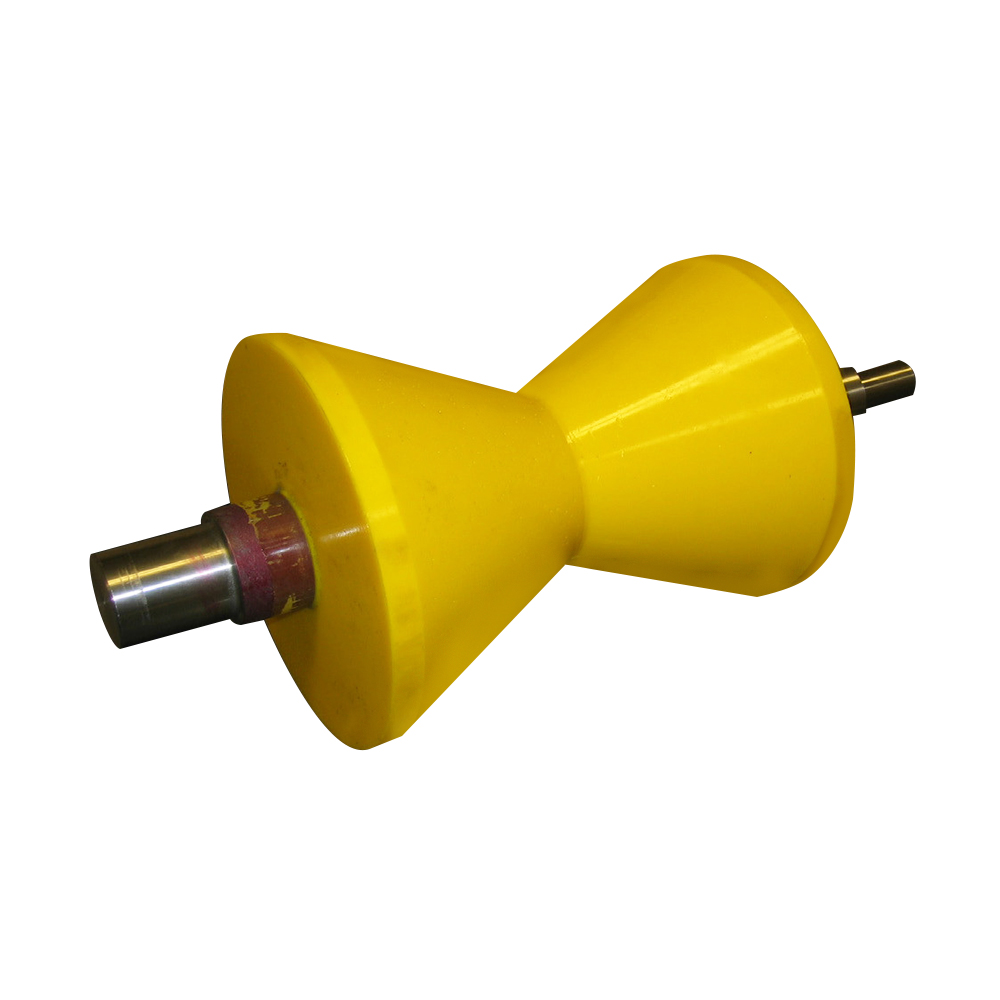
The geometry of the V-guide system provides a physical barrier against lateral drift. When a V-spliced belt mates with a grooved polyurethane V roller, the continuous interlocking profile forces the belt to track straight. This mechanical alignment is far more reliable than relying on friction alone. The V-guide acts as a continuous rudder. As lateral forces attempt to push the belt off-center, the side of the V-profile contacts the groove wall, physically stopping the drift. This system requires specific belting manufactured with a bonded V-profile on the bottom cover, matching the dimensions of the grooved rollers.
Urethane outlasts rubber and steel in abrasive, high-grit environments due to its exceptional tear resistance and tensile strength. Specifying the correct durometer on the Shore A or D scale ensures optimal load-bearing capacity and grip. A softer durometer provides better grip but may deform under heavy loads, while a harder durometer supports massive weight but offers slightly less traction. Urethane maintains a high coefficient of friction even when contaminated with dust, oil, or moisture. This prevents the belt from slipping out of the tracking groove during washdowns or in damp operating conditions.
| Material | Abrasion Resistance | Moisture Tolerance | Impact Absorption |
|---|---|---|---|
| Cast Polyurethane | Excellent | High | Excellent |
| Bare Steel | Good | Low (Rusts, slips) | Poor |
| Standard Rubber | Fair | Moderate | Good |
Solid-cast polyurethane rollers offer maximum durability for high-load systems. The urethane is chemically bonded directly to the steel core during the casting process, providing structural integrity under extreme stress. This prevents delamination when subjected to heavy side-loading. Conversely, retrofitting existing steel rollers with urethane sleeves offers a way to reduce noise and improve grip for lighter-duty lines. Sleeves are pressed or glued onto existing rollers. While effective for packaging lines or light manufacturing, sleeves lack the robust load capacity and shear strength of solid-cast options required for heavy bulk material handling.
In extreme environments, a mining conveyor roller must withstand massive loads, severe impacts, and constant exposure to abrasive dust. Polyurethane absorbs shock from heavy bulk materials dropping onto the belt, protecting the internal bearings from impact damage. It also resists chemical degradation from oils, acids, and ozone, ensuring long-term performance where standard rubber or steel components would quickly degrade. The high load-bearing capacity of hard-cast urethane prevents the roller from flattening out under the weight of crushed rock or ore, maintaining the precise geometry needed for the V-guide to function.
The urethane interface acts as a highly effective vibration dampener. This reduces decibel levels significantly compared to metal-on-metal contact, improving the working environment for plant personnel. The softer durometer prevents micro-tears on the belt's bottom cover. Steel rollers often develop sharp edges or rust pits that act like sandpaper against the belt. Polyurethane remains smooth and compliant, extending the operational life of the entire conveyor belt tracking system and reducing the frequency of expensive belt replacements.
Simple guidance wheels often ride on loose axles, making them prone to sliding and flat-spotting. When a wheel stops turning, the belt drags across it, quickly wearing a flat spot into the plastic or rubber. True precision rollers utilize integrated, sealed bearings on a fixed axis. This maintains true rotation under high lateral loads without introducing drag or power loss to the drive motor. Precision rollers support the belt across a wider surface area, distributing the load and preventing the concentrated wear patterns associated with narrow guidance wheels.
Specify V-guided systems for long center-to-center distances where belt wander becomes magnified over the length of the run. They are essential for side-loading applications where material hits the belt from an angle, constantly pushing it off-center. Reversing conveyors also benefit greatly, as standard tracking idlers only work in one direction. V-guides provide continuous, reliable alignment without constant intervention, making them ideal for environments where manual adjustment is hazardous, difficult to access, or requires shutting down critical production lines.
Standard crowning remains sufficient for short, lightly loaded conveyors operating in clean, dry environments. If the system handles lightweight packaged goods and the frame is perfectly square, crowned rollers provide adequate tracking. For non-critical systems where occasional manual adjustment does not impact overall plant output, standard rollers offer a functional solution without the need for specialized V-guided belting or grooved slider beds.
Evaluating the investment requires looking beyond the initial purchase price. Polyurethane components carry a higher upfront cost compared to bare steel. However, the extended lifespan in harsh environments drastically reduces replacement frequency. Maintenance labor drops significantly because technicians no longer spend hours adjusting take-up bearings. Furthermore, preventing belt edge damage saves thousands of dollars in premature belt replacement. The operational stability gained from continuous alignment translates directly to increased production uptime and reduced material spillage cleanup.
Upgrading a flat-belt system to a V-guided system presents specific engineering challenges. Slider beds, idler frames, and pulleys must be modified or replaced to accommodate the V-groove. A PU guide roller requires proper clearance to function correctly. If the groove in the slider bed is too shallow, the V-profile will bottom out, lifting the belt off the support surface and causing traction loss. The entire belt path must be audited to ensure the V-guide passes freely over return rollers and through the drive pulley without binding or excessive friction.
Industry-standard installation rules dictate precise alignment. The conveyor frame must be leveled and squared before installing the new rollers. Angling inclined rollers forward, typically 8 to 10 degrees at the belt edges in the running direction, optimizes the steering effect. This slight forward tilt uses the belt's forward motion to push the edges toward the center. However, over-angling increases friction, causing premature wear on the urethane surface and drawing higher motor amps due to the increased drag. Technicians must use laser alignment tools to ensure the rollers are set within tight tolerances.
A roller is only as reliable as its internal bearings. The urethane shell may last for years, but if the bearing seizes, the roller fails. Sealed or shielded bearings with high ABEC ratings and labyrinth seals are necessary to prevent premature failure from dust, slurry, and moisture ingress. In washdown environments, stainless steel bearings packed with food-grade grease provide the necessary protection. Regular inspection of the bearing seals and listening for abnormal noise during operation will identify failing bearings before they seize and damage the belt.
Polyurethane V rollers provide a highly effective, engineered solution for demanding applications where friction-based tracking fails. They mechanically lock the belt into alignment, overcoming the limitations of standard crowned rollers in wet, dusty, or heavy-load environments. Upgrading to this system requires careful planning, compatible belting, and precise installation to realize the full operational benefits.
A: It mechanically centers V-guided conveyor belts, providing a physical barrier that prevents lateral drift and ensures continuous alignment regardless of load distribution.
A: A PU guide roller uses the physical barrier of a V-groove to track the belt, whereas a crowned roller relies on tension-differential and friction, which often fails in wet conditions.
A: No, they require compatible V-guided belting and grooved pulleys or modified slider beds to accommodate the V-profile without lifting the belt.
A: Polyurethane offers superior abrasion resistance, higher load-bearing capacity, and better resistance to chemicals, oils, and moisture than standard industrial rubber.
A: Urethane maintains a high coefficient of friction and sheds water effectively, preventing the belt slippage and tracking loss common with smooth steel rollers.
A: Solid-cast rollers provide high load-bearing capacity for heavy materials, while sleeves are used to retrofit steel rollers for noise reduction in lighter applications.
A: Premature wear is typically caused by seized internal bearings, severe frame misalignment, over-angling the rollers, or specifying a durometer too soft for the application load.


