

Views: 0 Author: Site Editor Publish Time: 2026-07-05 Origin: Site


Premature roller failure in high-stress industrial environments drives up operational costs through unexpected line downtime and severe product damage. Plant managers and maintenance engineers constantly face a strict mechanical challenge on the floor. They must balance extreme load-bearing requirements with surface protection, chemical resistance, and continuous operational speeds. Standard rubber or bare metal components frequently force a compromise. You either sacrifice wear life for traction or give up surface protection for load capacity. Inadequate material selection directly impacts production efficiency and maintenance schedules, leading to frequent changeouts and ruined substrates.
The Polyurethane Roller serves as the engineered bridge between the elasticity of rubber and the structural integrity of metal. This material eliminates the need to compromise between grip and durability. By evaluating specific applications and formulations, facilities can optimize their material handling systems. Upgrading to engineered polymers ensures continuous operation under heavy loads while protecting sensitive materials from mechanical damage.
A successful roller upgrade requires clear success criteria established directly from floor-level observations. Facilities must define their operational goals before selecting materials. Common targets include extending maintenance intervals from weeks to months, achieving zero product marring on finished goods, and sustaining traction under wet or oily conditions. Food processing plants may also require strict compliance with FDA or USDA standards for direct contact. Defining these parameters ensures the selected polymer formulation directly addresses the root cause of previous component failures rather than just treating the symptoms.
Technical benchmarks validate material performance before installation. Engineers rely on specific physical testing standards to measure polymer capabilities against known operational stresses. ASTM D5963 measures abrasion resistance, indicating how well the material withstands continuous friction on a conveyor line. ASTM D412 evaluates tensile strength and elongation, determining the point of structural failure under extreme stretching or pulling. ASTM D2240 measures durometer hardness, which dictates load capacity and surface grip. These metrics provide a quantifiable baseline for comparing an industrial polyurethane roller against legacy materials that keep failing on the line.
Evaluating conceptual trade-offs between rubber, steel, and polyurethane clarifies material selection. Standard rubber offers excellent initial grip and conforms well to irregular surfaces. However, rubber remains highly susceptible to ozone degradation, tearing, and rapid wear under heavy loads, often leaving black marks or shedding particulate. Steel provides maximum load capacity and high heat resistance. The drawback is that bare metal causes surface damage to handled materials, lacks shock absorption, and transfers damaging vibrations through the equipment, leading to premature bearing failure.
Polyurethane offers the abrasion resistance of metal combined with the impact absorption of rubber. It bridges the performance gap between rigid and flexible materials. However, standard formulations have limitations. They can be susceptible to hydrolysis in high-heat and high-humidity environments. Engineers must specify specialized chemical formulations to prevent degradation when operating in these specific atmospheric conditions.
| Material | Load Capacity | Abrasion Resistance | Shock Absorption | Primary Limitation |
|---|---|---|---|---|
| Standard Rubber | Low to Medium | Low | Excellent | Rapid wear and ozone degradation |
| Bare Steel | Extreme | High | Poor | Surface marring and vibration transfer |
| Polyurethane | High to Extreme | Excellent | Good to Excellent | Heat buildup (hysteresis) at high speeds |
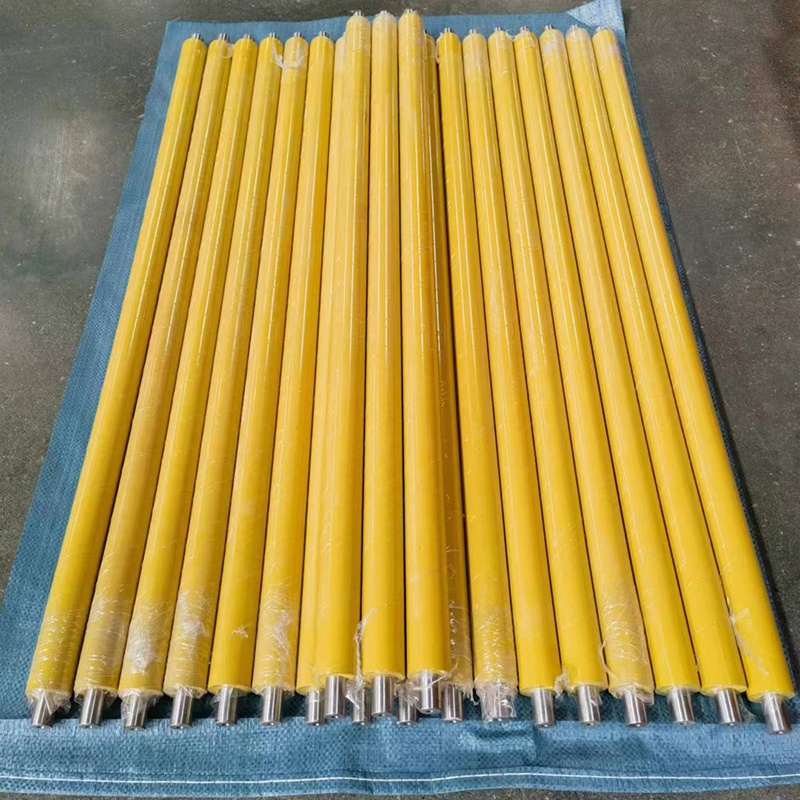
Material handling, warehousing, and conveyor systems rely heavily on durable components to maintain throughput. Mining operations, logistics hubs, and bulk material transport systems utilize the abrasion resistant roller to handle massive volumes of jagged, heavy materials. High-speed sorting facilities demand continuous operation without component degradation, as a single failed roller can jam an entire distribution center. Autonomous Mobile Robot (AMR) and Automated Guided Vehicle (AGV) drive systems require precise traction and load distribution to navigate warehouse floors accurately. Polyurethane provides exceptional impact absorption at conveyor transfer points where heavy items drop onto the line. It also significantly reduces operational noise compared to traditional steel idlers, improving the working environment for plant personnel.
Manufacturing and metal processing lines present unique mechanical challenges. Steel and aluminum coil processing requires specialized pinch rollers, tension rollers, bridle rollers, and squeegee rollers. These components must grip heavy, oiled metal coils securely without slipping. Polyurethane maintains high tension without marring polished metal surfaces. It prevents slippage during high-speed processing, ensuring consistent coil tension and protecting the final product finish from scratches that would result in rejected batches.
Printing, packaging, and converting equipment demand extreme precision and chemical resilience. High-speed web handling requires tight dimensional tolerances and dynamic balancing. Any runout or vibration causes print defects, uneven coating application, or catastrophic web tears. These environments also introduce harsh chemicals. Rollers face constant exposure to industrial inks, UV coatings, aggressive adhesives, and harsh cleaning solvents. Specialized polymer formulations resist these chemicals, preventing swelling, surface degradation, and premature failure that would otherwise halt the printing press.
Heavy industrial processing requires tailored solutions for specific materials. In woodworking and sanding, high-grip feed rollers must resist sawdust buildup while preventing surface marking on soft woods like pine or cedar. Glass manufacturing demands heat-stabilized formulations that handle fragile, heavy glass panels without scratching or cracking the edges. Automotive assembly and paint lines enforce strict silicone-free requirements. Silicone contamination causes paint cratering and adhesion failures, making pure, uncontaminated polyurethane essential for these critical production zones.
Durometer directly dictates load-bearing capacity and surface interaction. The Shore A scale measures flexible elastomers, while the Shore D scale measures rigid plastics. Matching the durometer range to the specific application is critical for success. Ranges between 20A and 50A suit delicate web handling and squeegee actions where conformity is needed. Hardness levels from 60A to 85A work best for general drive and idler applications requiring a balance of grip and wear. Heavy forklift wheels, high-load transport, and robust drive rollers require ratings between 90A and 75D to prevent deformation under massive weight.
| Durometer Range | Characteristics | Typical Industrial Applications |
|---|---|---|
| 20A - 50A | Very soft, high grip, conforms easily | Squeegee rollers, delicate web handling, light feed rollers |
| 60A - 85A | Medium hardness, good balance of wear and grip | Conveyor idlers, standard drive rollers, packaging equipment |
| 90A - 95A | Hard, high load capacity, excellent abrasion resistance | Heavy material handling, metal processing, AGV drive wheels |
| 60D - 75D | Very hard, rigid, extreme load bearing | Heavy forklift wheels, impact pads, structural rollers |
Environmental and chemical resistance determines the operational lifespan of a PU roller. Industrial environments expose components to oils, greases, hydraulic fluids, and aliphatic hydrocarbons daily. The base chemistry matters immensely. Polyether formulations provide superior resistance to moisture, hydrolytic degradation, and low temperatures, making them ideal for wet processing or cold storage. Polyester formulations deliver superior resistance to oil, fuel, solvents, and dry abrasion, making them the choice for metal stamping or printing. Selecting the wrong base chemistry leads to rapid material breakdown, swelling, and catastrophic failure.
Thermal dynamics and speed limitations require careful analysis before installation. Continuous cyclical deformation in high-speed applications causes internal heat buildup, known as hysteresis. Polyurethane acts as an insulator, trapping this generated heat within the core of the roller. Excessive hysteresis leads to internal melting, blowout, or flat-spotting under static loads when the machine stops. Engineers must evaluate thermal dissipation capabilities and operating speeds. Standard polyurethane typically caps operating temperatures around 180°F to 200°F. Specialized high-heat formulations can extend this limit to 250°F for demanding environments like curing ovens or hot-rolling mills.
Core material selection establishes the structural foundation of the roller. Aluminum cores offer low inertia and lightweight performance, ideal for high-speed starts and stops in packaging machinery. Steel cores provide high load capacity and extreme rigidity for heavy manufacturing. Composite or fiberglass cores offer chemical resistance and weight reduction for specific corrosive environments. The primary implementation risk is core deflection under load. Deflection causes uneven wear on the polymer coating, leading to premature failure at the edges. Engineers mitigate this by calculating proper core wall thickness and engineering robust shafts that resist bending.
The bonding process prevents catastrophic delamination on the floor. Chemical and mechanical bonding between the core and the polymer is critical. Coating separation occurs due to poor substrate preparation or thermal expansion mismatches between the metal and the urethane. You must specify vendors with documented surface-preparation protocols. These protocols should include precise shot-blasting to create a mechanical anchor pattern, thorough degreasing, and the application of specialized proprietary adhesive primer systems to ensure a permanent bond.
Surface finishes, profiles, and machining tolerances dictate functional performance. Secondary machining is often necessary for optimal operation. Crowning helps with continuous belt tracking on long conveyors. Specific grooving patterns, such as herringbone, chevron, spiral, or diamond, facilitate fluid dispersion and heat venting in wet or high-speed applications. High-speed or high-precision applications require strict tolerances. Defining acceptable Total Indicator Runout (TIR) and concentricity ensures smooth operation and prevents vibration-induced wear on a custom polyurethane roller.
Casting methodology impacts the final structural integrity of the covering. Liquid casting, whether gravity or centrifugal, proves superior to extrusion or injection molding for heavy-duty applications. Liquid casting preserves polymer chain length and ensures structural uniformity. It prevents internal stress concentrations and delivers consistent physical properties throughout the entire thickness of the roller covering, ensuring predictable wear rates.
Downtime reduction heavily outweighs initial unit costs when evaluating maintenance budgets. Calculating the true cost of a roller replacement requires looking beyond the purchase order. You must factor in maintenance labor to swap the part, replacement frequency, scrap rates from damaged products during the failure, and lost production time while the line is down. While engineered polymers require a higher initial investment than standard rubber, their extended operational life justifies the premium by keeping production lines running continuously and reducing emergency maintenance calls.
The recoating and recovering advantage offers significant long-term scalability for industrial plants. When the polymer surface eventually wears down after millions of cycles, the metal core usually remains intact and structurally sound. Recovering existing metal cores with new polyurethane significantly lowers long-term procurement costs. This practice eliminates the need to manufacture new metal substrates from scratch. It also supports industrial sustainability initiatives by keeping heavy metal cores out of landfills and reducing raw material consumption across the facility.
Polyurethane rollers represent the optimal engineering choice when operational bottlenecks stem from rapid abrasion, heavy load deformation, or chemical degradation. They bridge the gap between rubber and metal, providing durability without sacrificing surface protection. Proper specification ensures maximum production uptime and eliminates the constant headache of replacing chewed-up rubber components.
When evaluating vendors, prioritize those with in-house chemical formulation capabilities and documented bonding processes. Verify their precision machining tolerances, dynamic balancing services, and core-recovering capabilities to ensure long-term reliability on your production floor.
A: Polyurethane offers significantly higher load capacity and abrasion resistance than standard rubber. While rubber provides good initial grip, it degrades quickly under heavy stress, friction, and ozone exposure. Polyurethane maintains its elasticity while resisting physical tearing and chemical breakdown, resulting in a much longer operational lifespan under extreme industrial conditions.
A: Durometer selection depends entirely on your load and traction requirements. Lower durometers (20A-50A) provide high grip for delicate web handling. Medium durometers (60A-85A) suit general drive applications. High durometers (90A-75D) are required for heavy load transport to prevent physical deformation while maintaining structural integrity under massive weight.
A: Yes. The recoating process involves stripping the worn polymer, shot-blasting and cleaning the original metal core, applying new bonding agents, and casting fresh polyurethane. This process reuses the existing metal substrate, drastically reducing replacement costs and lead times compared to buying entirely new components.
A: Premature failure typically results from internal heat buildup (hysteresis) due to high speeds, chemical incompatibility with the operating environment, or flat-spotting from static heavy loads left in place too long. Core delamination is another major failure point, caused by inadequate surface preparation and bonding during the manufacturing process.
A: Yes, but the specific formulation matters. Polyester-based polyurethane provides excellent resistance to oils, fuels, and solvents. Polyether-based polyurethane is highly resistant to moisture and hydrolytic degradation. Selecting the correct base chemistry is critical for surviving specific chemical exposures on the production line.
A: Standard polyurethane formulations typically operate safely up to 180°F to 200°F. If temperatures exceed this range, the material can melt, blister, or degrade. Specialized high-heat formulations are available that can extend continuous operating thresholds up to 250°F for demanding thermal environments.
A: High rotational speeds amplify any weight imbalances in the roller. Without precise dynamic balancing, the roller will vibrate excessively. This vibration causes print defects, damages delicate webs, and leads to premature wear on both the urethane coating and the machine's internal bearings, eventually tearing the machine apart.


