

Views: 0 Author: Site Editor Publish Time: 2026-08-27 Origin: Site


Industrial equipment reliability depends entirely on material endurance. Premature wear on high-friction components causes compounding maintenance costs and unplanned downtime. Traditional wear materials like standard rubber, UHMW plastics, and carbon steel frequently fail under continuous impact. Heavy vibration and exposure to harsh industrial chemicals force maintenance teams into reactive replacement cycles. Replacing legacy materials with an engineered polyurethane sheet provides a measurable upgrade in structural integrity. This material improves energy absorption and abrasion resistance. It fundamentally shifts maintenance strategies from reactive responses to preventative solutions. You will learn how specific material properties mitigate equipment failure, how to specify the correct durometer, and where to apply these sheets for maximum operational uptime.
Extended Component Lifespan: Polyurethane significantly outlasts conventional rubber and standard plastics in high-abrasion environments, directly reducing part replacement frequency and long-term maintenance costs.
Vibration and Shock Mitigation: The high energy absorption capacity of polyurethane isolates structural vibrations, protecting sensitive fasteners, bearings, and adjacent machinery from fatigue.
Chemical and Environmental Resilience: Unlike natural rubber, polyurethane maintains structural integrity when exposed to mineral-based oils, greases, hydrocarbons, and industrial solvents.
Customizable Performance: Specifying the correct durometer, thickness, surface texture (e.g., anti-skid), and formulation is critical; success depends on matching the material properties to the specific mechanical load and environmental conditions.
Equipment reliability requires materials that can withstand severe operational stress without degrading. Engineers evaluate wear materials based on three primary success criteria. First, impact resistance determines how well a material absorbs kinetic energy without fracturing. When heavy aggregate drops onto a steel plate, the kinetic energy transfers directly into the structural supports. A proper wear material must absorb and dissipate that energy. Second, tensile strength measures the resistance to tearing under heavy mechanical loads. High-torque environments easily rip weak elastomers apart. Third, environmental stability dictates how the material performs across extreme temperature fluctuations and chemical exposures. A failure in any of these areas leads directly to mechanical breakdown. Establishing this baseline helps maintenance teams identify exactly where legacy materials fall short in high-stress industrial environments.
Field observations consistently show that ignoring these three criteria results in catastrophic equipment failure. For example, installing a high-tensile material that lacks environmental stability in an outdoor lumber yard guarantees premature degradation from UV exposure. Similarly, prioritizing impact resistance while ignoring chemical compatibility in a machining center leads to rapid material swelling. Maintenance personnel must evaluate the entire operational environment before selecting a wear material. Relying on outdated specifications or defaulting to the cheapest available rubber sheet directly undermines facility uptime and inflates annual maintenance budgets.
Natural and synthetic rubbers serve as standard isolation materials, but they possess critical chemical and structural vulnerabilities. Rubber remains highly susceptible to ozone degradation. Exposure to UV light and atmospheric ozone breaks down the polymer chains, causing the surface to crack and crumble. This process, known as dry rot, destroys rubber components even when they sit idle. Rubber also suffers from severe chemical breakdown when exposed to industrial fluids. Mineral oils, hydraulic fluids, and petroleum-based greases cause rubber components to swell, soften, and eventually disintegrate. A hydraulic leak dripping onto a rubber machine mount will destroy the mount's load-bearing capacity within weeks.
Furthermore, rubber offers significantly lower tear resistance under heavy shear loads. When a sharp object punctures a rubber pad, the tear propagates rapidly. This leads to immediate catastrophic failure of the component. In conveyor skirting applications, a single sharp rock can slice through standard rubber skirting, causing massive material spillage and requiring an immediate line shutdown for repairs. Rubber also suffers from compression set. After bearing a heavy load for an extended period, rubber loses its elastomeric memory and remains permanently flattened, completely negating its vibration isolation properties.
Carbon steel and rigid plastics offer high tensile strength but introduce different reliability issues. Steel adds excessive weight to machinery, increasing the energy required to operate moving parts. Metal-on-metal contact generates extreme noise levels and transfers shock directly into adjacent structural components. This constant impact accelerates metal fatigue and causes welds to crack over time. Using AR400 or AR500 steel plates in drop chutes certainly resists abrasion, but the resulting noise often violates occupational noise exposure limits, forcing facilities to build expensive sound enclosures.
Rigid plastics like standard PVC, acrylic, or basic UHMW provide a lighter alternative but risk severe brittleness. Under high-impact shock or in cold environments, these rigid plastics shatter or crack. They lack the elastomeric memory required to absorb sudden kinetic strikes. When a heavy load impacts a UHMW liner in freezing temperatures, the plastic frequently splinters. These materials are unsuitable for heavy material handling or high-vibration applications where flexibility and shock absorption are mandatory for equipment survival.
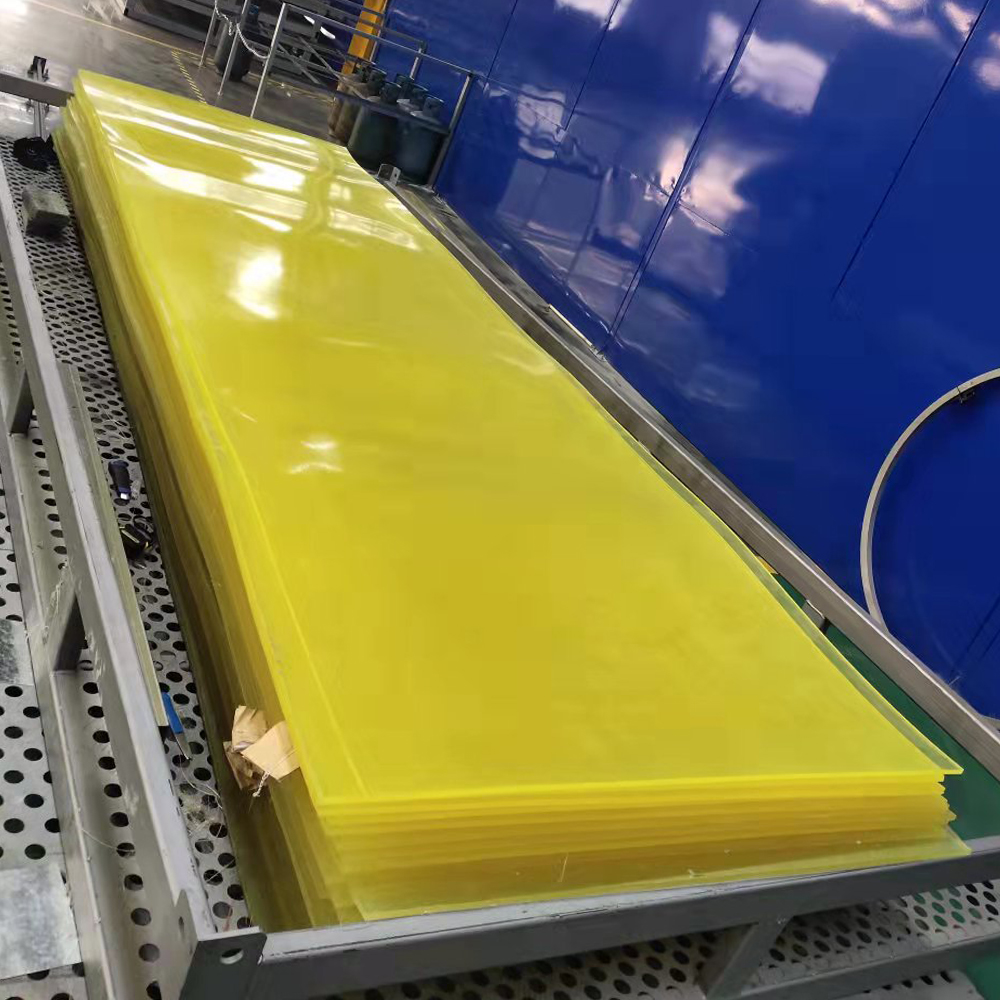
Polyurethane features a unique molecular structure combining hard and soft polymer segments. This cross-linked architecture allows a wear resistant polyurethane sheet to withstand continuous friction without shedding material. When abrasive particles strike the surface, the material yields slightly and then returns to its original shape. This elastomeric memory prevents the gouging and scratching that destroys rigid plastics. The material physically deflects the abrasive action rather than attempting to rigidly block it, which is why it outlasts steel in specific sliding abrasion applications.
Compared to standard elastomers, polyurethane demonstrates significantly lower abrasion loss metrics. In sand slurry tests and dry friction applications, polyurethane consistently outlasts natural rubber by margins of three to one. Its high tear strength ensures that even if the surface sustains a minor cut, the damage will not propagate under continuous mechanical stress. This makes it ideal for environments where sharp metal shavings, broken glass, or jagged aggregate constantly scrape against the equipment surfaces.
Heavy machinery generates intense structural vibrations that destroy bearings and loosen mechanical fasteners. Polyurethane excels at energy dissipation through a process called hysteresis. As kinetic energy enters the material, the polymer chains flex and convert that mechanical energy into trace amounts of heat. This dampening effect isolates the vibration at the source. Installing polyurethane pads beneath stamping presses or heavy motors prevents harmonic resonance from traveling through the facility floor. Without this isolation, the continuous vibration causes concrete foundations to crack and anchor bolts to pull out of the floor.
Dampening structural vibration directly extends the lifespan of adjacent machinery. It prevents the microscopic metal fatigue that leads to sudden shaft or gear failure. It also drastically reduces ambient noise levels. When metal parts impact a polyurethane surface instead of a steel plate, the sound wave is absorbed rather than reflected. This improves workplace safety and helps facilities comply with strict occupational noise exposure limits without requiring secondary soundproofing measures.
Industrial environments expose equipment to a constant barrage of harsh fluids. Polyurethane delivers exceptional chemical resistance, particularly against non-polar solvents. It maintains its structural integrity when submerged in hydrocarbons, cutting fluids, and heavy industrial greases. Unlike rubber, polyurethane does not absorb these fluids. Preventing material swelling is critical for maintaining tight mechanical tolerances. If a seal or isolation pad swells, it causes mechanical binding and friction buildup.
Polyurethane ensures that gaskets, scrapers, and protective linings retain their exact dimensional specifications regardless of oil exposure. This chemical stability ensures consistent equipment performance in refineries, automotive plants, and CNC machining centers. Maintenance teams do not have to worry about hydraulic fluid leaks dissolving their machine mounts or conveyor skirting. The material simply repels the oil and continues to perform its mechanical function.
Controlling surface friction is essential for power transmission and material transport. Polyurethane offers highly customizable friction coefficients. Utilizing anti-skid surface textures improves grip on drive rollers and conveyor belts. This prevents material slippage during transport, reducing product damage and clearing bottlenecks. High-friction polyurethane prevents drive belts from slipping under heavy torque loads, ensuring efficient power transfer. When a drive roller loses traction, the entire production line stalls, making friction control a direct component of facility uptime.
Conversely, engineers can formulate polyurethane with low-friction additives for applications requiring smooth sliding surfaces. Adding molybdenum disulfide or PTFE to the urethane blend creates a self-lubricating sheet. This precise control over traction enhances operational safety and prevents the sudden mechanical jerks associated with intermittent slipping. You can tailor the exact coefficient of friction to match the specific requirements of the machinery, whether you need maximum grip or zero resistance.
Bulk material handling destroys unprotected steel infrastructure. Abrasive goods like aggregate, coal, and grain scour the inside of chutes, hoppers, and transfer bins. Installing an industrial polyurethane liner protects the underlying steel substrates from continuous abrasion. The smooth surface of the liner prevents material bridging and buildup, ensuring a consistent flow rate. Wet or sticky materials that normally clog steel hoppers slide easily off the urethane surface, eliminating the need for personnel to manually clear blockages with sledgehammers.
Polyurethane liners absorb the impact of heavy rocks dropping into bins, preventing the steel from denting or deforming. This application drastically reduces the need for welding repairs and extends the operational life of the entire conveyor system. Instead of replacing a massive steel chute every six months, maintenance teams simply unbolt the worn urethane liner and bolt in a new one. This turns a multi-day welding project into a two-hour maintenance task.
Decoupling vibrating equipment from facility floors requires robust load-bearing isolation. Polyurethane serves as the ideal material for machine mounts, leveling pads, and heavy-duty bumpers. It supports immense compressive loads without permanent deformation. When a heavy load is removed, the pad returns to its original thickness. These isolation pads protect concrete foundations from cracking under the rhythmic impact of heavy presses. They also prevent precision equipment, like coordinate measuring machines (CMMs), from absorbing background facility vibrations.
Polyurethane bumpers absorb the kinetic energy of moving components, such as crane stops or automated guided vehicle (AGV) docking stations. They provide a controlled deceleration that prevents structural damage during hard impacts. A solid steel crane stop transfers the entire shock of a collision directly into the building's I-beams. A polyurethane bumper compresses, dissipates the energy, and protects both the crane and the building infrastructure from catastrophic damage.
Fluid-heavy and high-particulate environments require reliable barrier components. Precision-cut polyurethane sheets act as superior gaskets and seals in slurry pumps and chemical vats. Their resistance to both abrasion and chemical degradation makes them perfect for scraping applications. Polyurethane belt scrapers remove sticky or abrasive residue from conveyor belts without damaging the belt material. Unlike rigid metal scrapers that can slice a conveyor belt if misaligned, a urethane scraper flexes just enough to clean the surface safely.
Snowplow blades and street sweeper skirts utilize polyurethane to scrape rough asphalt without degrading rapidly. These barrier components maintain a tight seal over millions of cycles, preventing fluid leaks and particulate contamination in sensitive machinery. In wastewater treatment plants, urethane squeegees on clarifier tanks outlast standard rubber equivalents by years, drastically reducing the frequency of tank draining for maintenance.
Industrial facilities face constant abuse from vehicular traffic and heavy equipment movement. Applying polyurethane sheets as protective coatings or physical barriers safeguards building components. Facilities install polyurethane wall guards, corner protectors, and column wraps in high-traffic forklift zones. When a forklift strikes a protected column, the polyurethane absorbs the shock, preventing concrete spalling and structural compromise.
These durable barriers require zero maintenance and outlast traditional steel or rubber guards. They protect the facility infrastructure while simultaneously reducing damage to the material handling vehicles themselves. Repairing a spalled concrete column requires specialized contractors, structural shoring, and significant downtime. Wrapping that column in a high-density urethane sheet eliminates the risk entirely, providing passive protection that operates 24/7.
Specifying the correct material hardness dictates the success of the application. Polyurethane hardness is measured on the Shore scale. Shore A covers softer, flexible materials, while Shore D measures harder, rigid formulations. Selecting the wrong durometer leads to immediate mechanical failure. A material that is too soft will tear under heavy loads, while a material that is too hard will shatter under impact.
Durometer Range | Material Characteristics | Ideal Industrial Applications |
|---|---|---|
60A - 75A | High flexibility, excellent grip, high energy absorption. | Drive rollers, light vibration pads, custom gaskets. |
80A - 95A | Balanced toughness, high abrasion resistance, moderate flex. | Conveyor liners, belt scrapers, heavy machine mounts. |
60D - 75D | Rigid, high load-bearing capacity, extreme impact resistance. | Heavy duty bumpers, structural bearings, metal replacements. |
Engineers must test the specific impact and load requirements before selecting a durometer. For instance, a 90A sheet provides the perfect balance of abrasion resistance and flexibility for a grain chute. However, if that same chute handles heavy, jagged iron ore, the 90A material might cut. In that scenario, shifting to a harder 65D formulation or increasing the thickness of the 90A sheet becomes necessary to handle the increased kinetic energy.
Thickness requirements depend entirely on impact severity and spatial constraints within existing machinery. A thin sheet provides surface protection against fine sliding abrasion, such as sand moving down a slide. Heavy impact from large aggregate requires a much thicker sheet to absorb the kinetic energy before it reaches the substrate. Engineers must evaluate the available clearance inside chutes and housings before specifying thickness. If a liner is too thick, it restricts material flow and causes bottlenecks.
Integrating flat sheets with complementary form factors creates comprehensive equipment upgrades. Combining sheet liners with polyurethane rod stock, tubes, and custom-molded parts ensures that every wear point in the system receives the appropriate elastomeric protection. You must account for thermal expansion when sizing these sheets. Polyurethane expands and contracts with temperature changes more than steel. Leaving appropriate expansion gaps during installation prevents the sheet from buckling or warping during peak summer temperatures.
Standard off-the-shelf materials cannot solve every engineering challenge. Highly specialized environments require a custom polyurethane sheet tailored to exact operational parameters. Food processing facilities require FDA-compliant formulations that resist bacterial growth and withstand high-pressure chemical washdowns. Standard industrial urethane will degrade under daily exposure to caustic cleaning agents. Electronics manufacturing requires anti-static (ESD) additives to prevent electrostatic discharge from damaging sensitive components.
Outdoor applications demand UV stabilizers to prevent sunlight degradation. Without these stabilizers, the urethane will eventually chalk and lose its tensile strength. Furthermore, engineers must evaluate backing options. Fabric-backed sheets allow for high-strength adhesive bonding. Metal-backed sheets, typically utilizing expanded metal mesh embedded in the urethane, provide structural rigidity. This allows for secure mechanical fastening using standard bolts, preventing the material from sagging, stretching, or tearing under heavy vertical loads.
Polyurethane acts as an excellent thermal insulator, which presents a specific engineering risk. It retains heat generated by continuous friction. If the material cannot dissipate this heat, the internal temperature rises rapidly. Polyurethane becomes unsuitable for high-speed, high-friction applications that exceed specific temperature thresholds. Most standard formulations begin to degrade, soften, or melt when continuous operating temperatures exceed 180°F to 200°F.
Engineers must calculate the friction-induced heat in high-speed sliding applications. A conveyor belt running at high speeds over a urethane slider bed will generate significant thermal energy. If the environment exceeds these thermal limits, the urethane will experience thermal runaway, melting from the inside out. In these specific high-heat scenarios, alternative materials like ceramic tiles or specialized high-temp metal alloys must be utilized to prevent catastrophic mechanical failure.
Improper installation guarantees premature failure regardless of material quality. Mitigating the risk of delamination or tearing at mounting points requires precise fastening techniques. Mechanical fastening remains the most reliable method for heavy-duty applications. Installers must use countersunk bolts, elevator bolts, or heavy-duty washers to distribute the clamping force. If bolt heads protrude above the sheet surface, abrasive materials will destroy the fasteners immediately, causing the liner to fall into the machinery.
Identify the primary direction of material flow to overlap sheet joints correctly, preventing material from catching the leading edge.
Counter-bore all fastening holes so the bolt heads sit at least 1/4 inch below the wear surface.
Apply a high-strength thread locker to all nuts and bolts to prevent vibration-induced loosening.
If using adhesives, sandblast the steel substrate to a near-white metal finish and degrease thoroughly before applying the bonding agent.
Adhesive bonding offers a seamless surface but requires meticulous preparation. Using fabric-backed polyurethane drastically improves the peel strength of structural epoxies, ensuring the sheet remains bonded under heavy shear loads. However, adhesive bonding makes future replacements more labor-intensive, as the old adhesive must be mechanically ground off the steel before a new sheet can be applied.
Procurement teams often hesitate at the higher initial procurement cost of polyurethane compared to commercial rubber. However, evaluating the material based solely on upfront purchase price ignores the operational reality. Polyurethane delivers a massive return on investment through lifecycle longevity. It drastically reduces emergency maintenance interventions. Fewer replacement parts mean less labor spent on repairs and less risk of safety incidents during heavy maintenance tasks.
Most importantly, polyurethane increases Overall Equipment Effectiveness (OEE) by eliminating unplanned downtime. When a production line remains operational for months instead of weeks without requiring a liner replacement, the initial material premium pays for itself rapidly. The true value of the material lies in sustained manufacturing output. Facilities that transition to urethane wear parts consistently report higher production yields simply because they do not have to stop the line to patch holes in steel chutes or replace shredded rubber skirting.
Conduct a comprehensive wear-point audit on all existing material handling and processing machinery to identify high-failure zones.
Document the precise operating temperatures, chemical exposures, and kinetic impact loads for each identified wear point.
Consult with a specialized manufacturer to specify the exact durometer, surface texture, and chemical formulation required for your environment.
Standardize installation procedures, choosing between countersunk mechanical fasteners or structural adhesives based on shear load requirements.
Track equipment uptime and maintenance intervals post-installation to measure the direct improvement in Overall Equipment Effectiveness.
A: Polyurethane offers significantly higher tensile strength and abrasion resistance than standard rubber. It outlasts rubber in high-friction environments and resists tearing under heavy loads. Additionally, polyurethane maintains exceptional chemical stability when exposed to mineral oils and hydrocarbons, whereas natural rubber swells, softens, and degrades rapidly in the same conditions.
A: Choose based on the mechanical load. The Shore A scale measures softer materials ideal for flexibility, grip, and light vibration dampening. The Shore D scale measures harder, rigid materials required for high load-bearing capacity, extreme impact resistance, and heavy machine mounts. Match the hardness to your specific impact and traction needs.
A: Polyurethane has strict thermal limits. Standard formulations operate safely up to 180°F - 200°F. Because polyurethane is an insulator, it retains friction-induced heat. Exceeding these temperature thresholds causes the material to soften, degrade, or melt, leading to mechanical failure in high-speed, high-friction applications.
A: Polyurethane can be machined, but heat buildup must be controlled. Waterjet cutting is the most precise and heat-free method for custom shapes. Die-cutting works well for thinner sheets. If using traditional machining tools, use sharp blades, slow feed rates, and proper coolants to prevent the material from melting during the cut.
A: Yes, polyurethane demonstrates strong resistance to mineral-based oils, cutting fluids, greases, and most hydrocarbons. It does not swell or lose tensile strength in these environments. However, it is vulnerable to certain harsh acids, strong bases, and highly polar solvents, which require specialized chemical compatibility testing.
A: Attachment depends on the load. Mechanical fastening using countersunk bolts prevents fastener wear and is best for heavy impact. Structural adhesives work well for seamless linings, provided the metal is sandblasted and degreased. Metal-backed or fabric-backed polyurethane sheets offer the most secure mounting options for high-stress applications.


