

Views: 0 Author: Site Editor Publish Time: 2026-07-01 Origin: Site


Pipeline failure, unplanned downtime, and frequent maintenance compound rapidly in highly abrasive industrial environments. Pumping aggressive materials through unprotected infrastructure destroys steel walls, leading to catastrophic leaks and halted operations. Solving this requires a reliable barrier between the aggressive fluid and the structural containment shell.
Selecting the optimal abrasion resistant pipe requires navigating complex trade-offs. You must balance installation logistics against the specific physical and chemical characteristics of the transported material. A mismatch here guarantees premature wear and operational bottlenecks that disrupt entire processing facilities.
This guide provides a rigorous, engineering-focused framework for evaluating pipeline materials. We will determine whether Polyurethane Lined Pipe is the correct specification for your specific application. You will learn how to assess slurry characteristics, compare material alternatives, and verify technical specifications to ensure long-term operational success without relying on generic manufacturer claims.
You must audit the slurry profile before selecting any material. The physical makeup of the pumped fluid dictates the wear mechanism. Particle size distribution heavily influences how solids interact with the pipe wall. Fine particles cause uniform sliding wear, while larger rocks create impact damage. Particle shape matters equally. Angular, sharp-edged particles slice through soft materials, whereas round particles cause blunt friction.
Slurry density and flow velocity determine the kinetic energy transferred to the pipeline. High-velocity flows increase the abrasion rate exponentially. Additionally, pH levels dictate chemical compatibility. You must analyze these variables together to specify an effective mining slurry transport system. A failure to map these characteristics leads to rapid liner degradation.
| Slurry Characteristic | Impact on Pipeline Wear | Measurement / Consideration |
|---|---|---|
| Particle Size | Determines sliding vs. impact abrasion. | Sieve analysis (mesh size). |
| Particle Shape | Angular particles cut; round particles rub. | Microscopic evaluation. |
| Flow Velocity | Exponentially increases kinetic energy and wear rate. | Meters per second (m/s). |
| Slurry Density | Heavier slurries increase bottom-quadrant wear. | Specific gravity. |
| pH Level | Drives chemical corrosion and polymer degradation. | Standard pH scale (0-14). |
Chemical corrosion and mechanical abrasion combine to accelerate wear. This synergism destroys bare steel rapidly. The fluid chemically attacks the metal, forming a soft oxide layer. Abrasive particles then strip this layer away, exposing fresh metal to further chemical attack. The cycle repeats, thinning the pipe wall at an alarming rate.
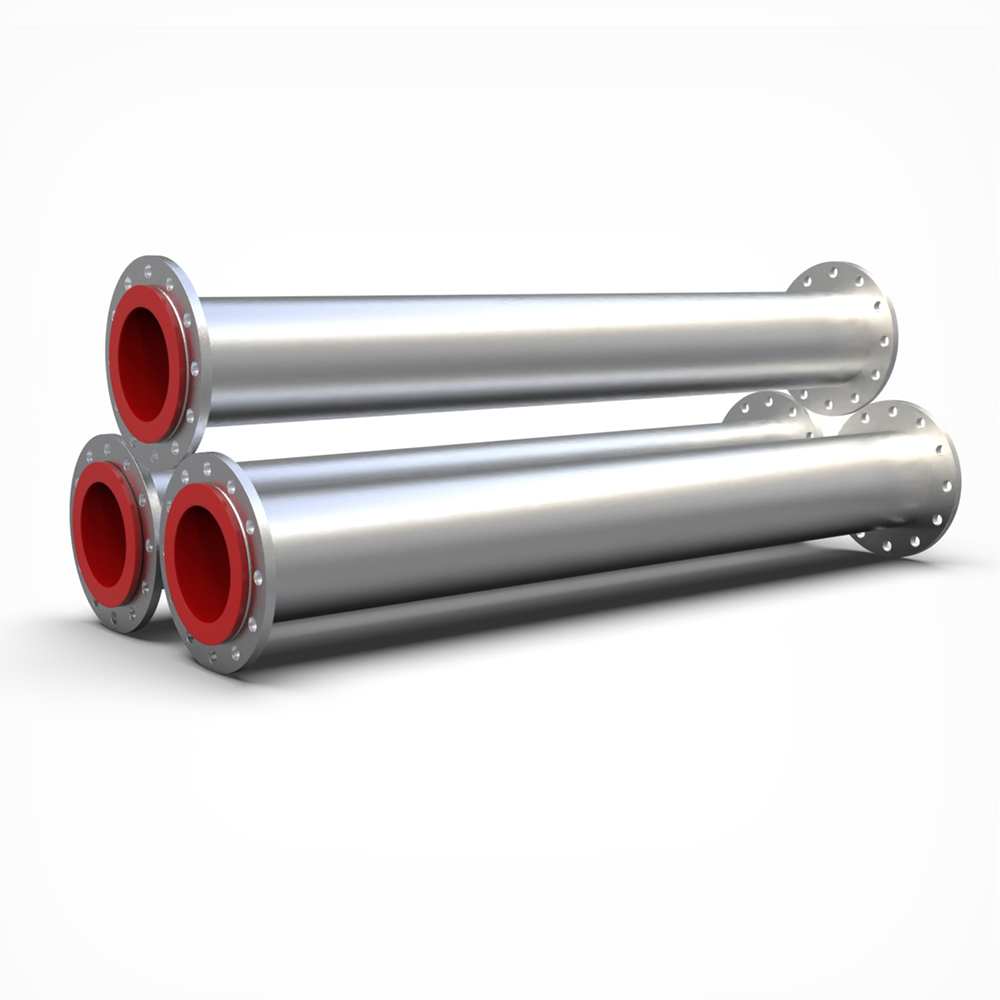
A polyurethane lining pipe acts as an impermeable barrier. It interrupts this destructive cycle by isolating the structural steel from the chemical fluid. The elastomer absorbs the mechanical friction while resisting chemical degradation, preserving the structural integrity of the containment shell. This separation of duties allows the steel to handle pressure while the polymer handles the wear.
Processing plant piping faces high turbulence. Complex manifolds, high-velocity elbows, and T-pieces force the fluid to change direction rapidly. This creates localized high-wear zones requiring thick, highly resilient liners. Space constraints often dictate custom spool lengths and specialized fittings. You will often see accelerated wear on the outer radius of elbows in these facilities.
Overland pipelines operate differently. These long-distance cross-country routes prioritize constant pressure and uniform flow. Head loss optimization becomes critical over kilometers of pipe. The internal surface must remain exceptionally smooth to maintain flow efficiency. The design criteria shift from managing localized impact to ensuring consistent sliding abrasion resistance across vast distances.
You must define Key Performance Indicators (KPIs) to measure pipeline performance objectively. Without hard data, material evaluation becomes guesswork.
Slurry pipelines fail through several distinct mechanisms. Gouging occurs when sharp particles carve deep grooves into the liner. Sliding wear uniformly thins the material as fine particulates drag along the bottom quadrant of the pipe. Chemical degradation breaks down the polymer chains, causing swelling or embrittlement.
Cavitation damages pipelines when localized pressure drops cause vapor bubbles to form and violently collapse against the wall. Understanding these failure modes sets the stage for selecting the right protective barrier. Different elastomers address these specific threats with varying degrees of success. You must match the material to the dominant failure mode observed in your facility.
Rubber absorbs high-impact forces exceptionally well. It deflects and rebounds when struck by large, heavy rocks, making it ideal for primary discharge lines. However, rubber struggles with sliding abrasion from sharp-edged particulates. Sharp particles can tear chunks of rubber away, leading to rapid localized failure.
Polyurethane offers superior cut and tear resistance. It excels in sliding abrasion environments where fine-to-medium particles dominate. The dense polymer structure resists slicing, maintaining a smooth surface far longer than natural rubber under sliding friction. You must choose based on whether impact or sliding wear dominates your system.
| Feature | Polyurethane Liner | Rubber Liner |
|---|---|---|
| Primary Strength | Sliding abrasion, cut resistance. | Impact absorption, rebound. |
| Ideal Particle Size | Fine to medium (sand, tailings). | Large, heavy (primary ore). |
| Friction Coefficient | Very low (smooth surface). | Higher (creates more drag). |
| Tear Resistance | Excellent. | Moderate to Poor (against sharp edges). |
Traditional unlined steel suffers from rapid abrasive wear and corrosion. Metallic liners, like chromium carbide overlay, offer extreme hardness but lack flexibility. They are heavy, difficult to install, and prone to cracking under vibration or thermal shock. Field welding metallic liners requires specialized procedures that complicate maintenance.
A polyurethane lined system utilizes the steel purely for pressure containment. The internal polymer acts as a sacrificial, highly resilient barrier. It weighs significantly less than metallic overlays and provides a smooth hydraulic surface that steel cannot maintain once pitting begins. This composite approach leverages the best properties of both materials.
High-Density Polyethylene (HDPE) provides excellent chemical resistance and a low friction coefficient. However, solid HDPE pipes lack structural rigidity. They deform under high internal pressure, vacuum conditions, or heavy external soil loads. Temperature fluctuations cause significant thermal expansion and contraction in HDPE, requiring complex anchoring systems.
Steel-backed polyurethane maintains strict structural integrity. The steel outer shell handles high-pressure ratings and external loads effortlessly. The internal polyurethane liner provides the necessary wear resistance without compromising the mechanical stability of the pipeline network. You get the wear benefits of a polymer with the structural reliability of carbon steel.
Specifying the correct polyurethane formulation requires understanding durometer ratings. Softer urethanes (around 70-80 Shore A) provide better impact absorption. They flex and rebound when struck. Harder urethanes (90-95 Shore A) offer superior sliding abrasion resistance and a lower friction coefficient, improving flow efficiency.
You must match the hardness to the particle size and velocity. A formulation that is too hard may chip under impact, while one that is too soft may drag and increase pumping resistance. Custom blending allows manufacturers to dial in the exact wear resistance profile needed for your specific slurry pipeline liner application.
Standard polyurethane degrades in highly acidic or alkaline environments. Moisture and chemical exposure dictate the base chemistry required. Ester-based polyurethanes offer excellent abrasion resistance but suffer from hydrolysis in wet environments. They break down when exposed to water over time, turning brittle and flaking away.
Ether-based polyurethanes provide superior hydrolytic stability. They resist water degradation and handle a broader pH range. You must specify ether-based formulations for wet slurry transport to prevent premature chemical breakdown of the liner. Always consult the manufacturer's chemical compatibility charts before finalizing the specification.
Never specify a liner based on marketing claims. Demand laboratory test data to validate performance. The ASTM G75 (Miller Number) test measures slurry abrasivity and the relative wear response of the material. DIN 53516 or ISO 4649 standards quantify sliding abrasion resistance through volume loss measurements.
ASTM D4060 (Taber Abrasion) provides further data on wear characteristics. Beyond lab tests, review field trial documentation. Historical performance curves from similar operational environments offer the most reliable indicator of how the material will perform in your facility. Request case studies that match your specific slurry profile.
| Testing Standard | Purpose | What to Look For |
|---|---|---|
| ASTM G75 | Miller Number / Slurry Abrasivity | Low wear response relative to standard materials. |
| DIN 53516 / ISO 4649 | Sliding Abrasion Resistance | Low volume loss (measured in cubic millimeters). |
| ASTM D4060 | Taber Abrasion | Weight loss after specified cycles under load. |
| ASTM D429 | Adhesion to Rigid Substrates | High peel strength indicating a secure bond to steel. |
Polyurethane possesses strict thermal limits. Most standard formulations max out between 60°C and 80°C. Exceeding these temperatures causes thermal degradation. The material softens, loses its abrasion resistance, and eventually melts or reverts to a semi-liquid state.
High-heat applications require specialized high-temperature formulations, but even these have absolute limits. You must monitor fluid temperatures continuously. If the process regularly exceeds 80°C, you must consider alternative materials to prevent catastrophic liner failure. Do not push polyurethane past its thermal boundaries.
The steel-to-polyurethane bond dictates the structural integrity of the liner. Delamination is the primary failure risk. If the bond fails, the liner collapses inward, blocking flow and destroying the pipeline. Achieving a permanent bond requires meticulous surface preparation.
The steel must be sandblasted to a specific profile to create mechanical tooth. Proprietary primers are then applied before the polyurethane is cast or spun into the pipe. Strict curing processes ensure the chemical bond cross-links perfectly. You must verify the manufacturer's adhesion testing protocols to guarantee vacuum and high-velocity resistance.
Logistical realities impact pipeline longevity before the system even operates. Polyurethane is susceptible to UV degradation during long-term outdoor storage. Prolonged sunlight exposure causes the polymer to harden and crack. You must store lined spools under cover or use UV-resistant end caps.
Installation requires specific handling procedures. Dropping a pipe or dragging it across rough terrain can damage the flanged ends. The liner often flares over the flange face to create a built-in gasket. Damaging this flare ruins the seal, guaranteeing a leak upon pressurization. Crews must use soft slings and proper rigging techniques.
Vetting manufacturers requires a strict quality assurance checklist. Demand holiday testing on every spool. This spark test runs high voltage across the liner to detect microscopic pinholes that would allow fluid to reach the steel. Reject any pipe that fails this test.
Concentricity checks ensure uniform liner thickness. An off-center liner leaves one side dangerously thin, leading to premature wear. Documented peel adhesion tests prove the bonding process meets specification. A reliable manufacturer will provide these QA reports for every batch of pipe delivered.
Operational monitoring prevents catastrophic blowouts. Non-destructive testing (NDT) methods allow you to track wear without halting production. Ultrasonic thickness gauging measures the remaining steel wall, but specialized techniques are required to measure the polymer liner accurately through the steel.
Wear indicator layers offer a visual solution. Manufacturers can cast a dual-color polyurethane liner. When the primary inner color wears away, the contrasting base color becomes visible during visual inspections. This provides a clear, undeniable signal to safely plan maintenance outages before the steel shell is compromised.
Take immediate action to secure your pipeline infrastructure. Implement the following steps to ensure proper material specification and system reliability:
A: Standard polyurethane formulations typically have a maximum operating temperature between 60°C and 80°C. Exceeding this limit causes thermal degradation, where the material softens, loses its abrasion resistance, and risks reverting to a semi-liquid state, leading to complete liner failure.
A: Rubber excels at absorbing high-impact forces from large, heavy rocks due to its rebound characteristics. Polyurethane offers superior cut and tear resistance, making it much more effective against sliding abrasion from fine-to-medium, sharp-edged particles that would otherwise slice through rubber.
A: Yes, but the formulation matters. Ether-based polyurethanes provide excellent hydrolytic stability and resist water degradation, handling a moderate pH range. Ester-based formulations break down in wet or highly acidic/alkaline environments. Always verify chemical compatibility with the manufacturer.
A: While highly application-dependent, field data frequently shows polyurethane outlasting unlined steel by a factor of 4 to 10 times in sliding abrasion environments. The exact multiplier depends on flow velocity, particle sharpness, and slurry density.
A: The steel is sandblasted to create a mechanical profile. Proprietary chemical primers are applied, and the polyurethane is cast or spun into the pipe. A controlled curing process ensures a permanent cross-linked bond, preventing delamination under vacuum or high-velocity conditions.
A: Yes. Manufacturers supply custom polyurethane-lined elbows, T-pieces, reducers, and manifolds. These fittings are critical for protecting high-turbulence zones where fluid changes direction, as abrasion rates are exponentially higher in these areas compared to straight spools.
A: Request ASTM G75 (Miller Number) for slurry abrasivity response, DIN 53516 or ISO 4649 for sliding abrasion volume loss, and ASTM D4060 (Taber Abrasion). Additionally, demand holiday (spark) testing and peel adhesion test reports for quality assurance.


