

Views: 0 Author: Site Editor Publish Time: 2026-06-30 Origin: Site


Unplanned downtime and equipment degradation caused by aggressive material handling in chutes, hoppers, and bins drive up operational costs and disrupt production schedules. The engineering challenge lies in balancing wear life, material flow, and installation feasibility across diverse industrial environments. Defaulting to standard steel or rubber often results in premature failure, material hang-ups, or excessive maintenance overhead that drains facility resources.
A structured evaluation process is necessary for selecting the correct Polyurethane Sheet. By focusing on durometer ratings, backing types, and environmental constraints, plant engineers can specify materials that withstand severe abrasion while maintaining structural integrity. Aligning the physical properties of the urethane with the specific wear mechanisms of the application ensures optimal long-term operational efficiency and significantly reduces the frequency of replacement cycles.
Abrasion-resistant (AR) steel has long been the traditional choice for heavy-duty material handling, but it presents significant drawbacks regarding weight and material flow. Polyurethane offers a superior weight-to-wear ratio, often weighing up to 80% less than steel plates of comparable dimensions. This weight reduction drastically improves installation ergonomics, allowing maintenance crews to replace sections without requiring heavy lifting equipment or extensive rigging.
In regulatory-heavy and urban-adjacent environments, noise pollution is a strict operational constraint. Polyurethane provides exceptional decibel dampening, absorbing the acoustic energy generated by aggregate impact that steel typically amplifies. Furthermore, the low coefficient of friction inherent to urethane prevents material sticking and carryback. While oxidizing steel surfaces create friction points that lead to bridging and caking, polyurethane maintains a slick surface that promotes continuous, uninterrupted material flow even with high-moisture aggregates.
Rubber is frequently utilized for impact absorption, but it falls short when subjected to sharp-particle impingement. Polyurethane demonstrates vastly superior tear resistance and load-bearing capacity under the stress of jagged, cutting materials. When sharp rocks or glass cullet strike a rubber surface, the material tends to gouge and tear, leading to rapid degradation. Polyurethane absorbs the kinetic energy while resisting the cutting action, maintaining its structural boundary far longer than natural rubber.
Chemical compatibility further separates the two materials. Natural rubber degrades rapidly when exposed to tramp oils, industrial greases, and certain solvents common in processing facilities. Polyurethane formulations can be engineered to resist these specific hydrocarbons, ensuring the liner does not swell, soften, or lose its abrasion-resistant properties when subjected to chemical contamination alongside physical wear.
| Material | Impact Resistance | Sliding Abrasion | Chemical Resistance | Weight Profile |
|---|---|---|---|---|
| Polyurethane | High (Absorbs energy) | Excellent (Low friction) | High (Customizable) | Lightweight |
| AR Steel | Very High (Rigid) | Moderate (Prone to caking) | Low (Oxidizes) | Very Heavy |
| Natural Rubber | High (Bounces) | Low (Gouges easily) | Low (Degrades in oil) | Moderate |
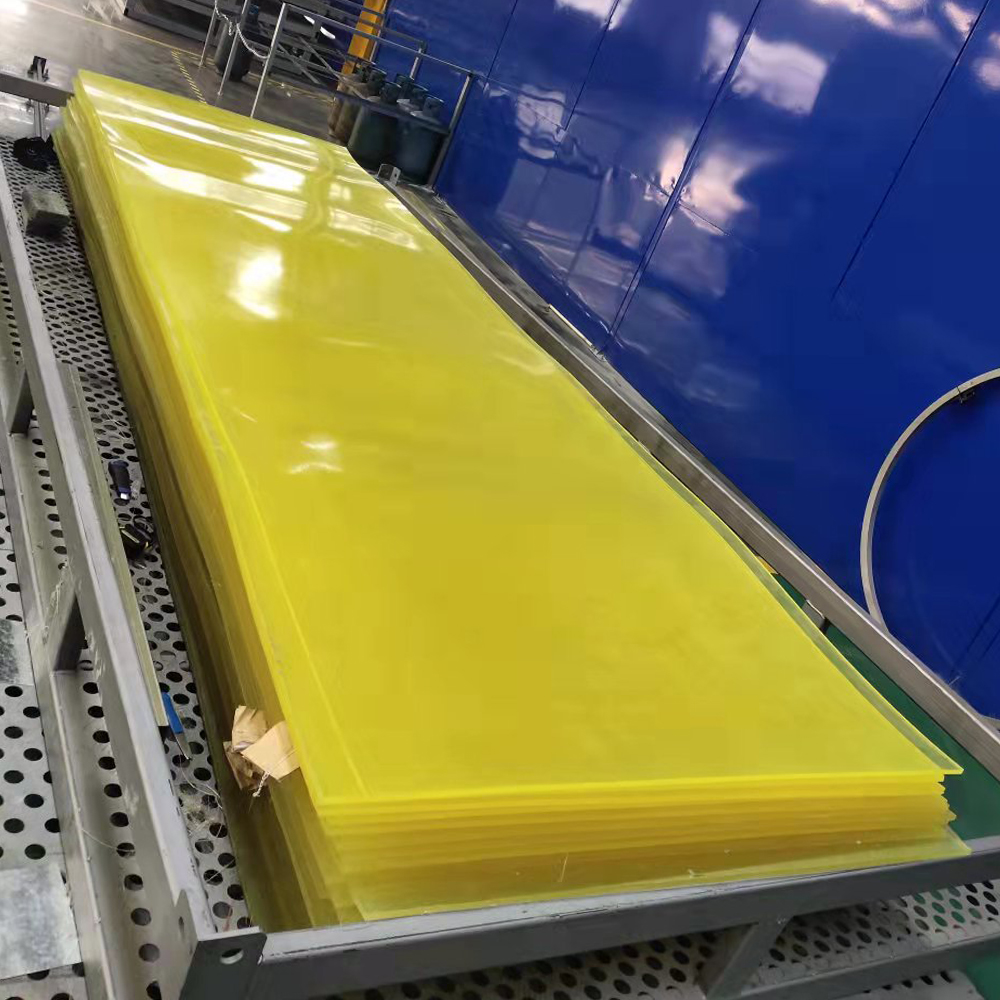
The Shore A and Shore D durometer scales measure the hardness of elastomeric materials, serving as the primary indicator of how a liner will respond to different types of physical stress. Selecting the correct polyurethane sheet hardness dictates the maximum wear life you can achieve. The Shore A scale covers softer, more flexible urethanes, while the Shore D scale is reserved for rigid, highly durable formulations.
For high-impact, impingement zones where heavy materials drop directly onto the surface, softer durometers ranging from 60A to 75A are recommended. These softer sheets act like a trampoline, absorbing and deflecting the kinetic energy of falling aggregate without fracturing. Conversely, for sliding abrasion where materials scrape along the surface, harder durometers between 85A and 95A are required. The increased rigidity prevents sharp particles from cutting or gouging the surface as they move across the chute or hopper.
Standard industrial urethane sheets are manufactured in thickness ranges from 1/4 inch up to 2 inches or more. Calculating the required thickness depends on expected wear rates, material throughput, and scheduled maintenance intervals. Thicker sheets provide a longer operational lifespan but reduce the internal volume of the hopper or chute, which can bottleneck high-capacity systems.
Standard sheet sizing typically includes 4' x 8', 4' x 10', and 5' x 10' dimensions. When specifying these sheets, engineers must account for tolerance allowances related to thermal expansion. Polyurethane expands and contracts with temperature fluctuations more significantly than steel. Proper gap spacing during installation is required to prevent buckling or warping when the facility experiences extreme seasonal temperature shifts.
Procuring standard bulk polyurethane sheets requires on-site fabrication, including cutting, drilling, and fitting the material to the specific geometry of the equipment. This approach offers lower initial material acquisition costs but demands higher on-site labor time and generates waste material from off-cuts.
Custom pre-engineered, drop-in liners are cast to the exact specifications of the chute, bin, or hopper. While the upfront cost is higher, custom liners drastically reduce installation downtime and eliminate on-site fabrication errors. The fit precision of custom-molded parts ensures seamless joints, which prevents abrasive fines from migrating beneath the liner and causing premature detachment.
Tensile strength measures the force required to pull the polyurethane apart, while elongation indicates how much the material can stretch before breaking. Tear resistance evaluates the material's ability to withstand the propagation of a cut or nick. These three metrics directly correlate to a liner's capacity to handle sharp, jagged aggregate without experiencing catastrophic tearing.
For heavy-duty industrial applications, baseline acceptable metrics typically require a tensile strength exceeding 4,000 psi and a tear strength above 400 pli (pounds per linear inch). Materials that fail to meet these thresholds are highly susceptible to rapid degradation when subjected to crushed ore, sharp gravel, or recycled glass.
Plain and fabric-backed sheets are primarily utilized in low-to-medium impact areas where adhesive bonding is the preferred installation method. The fabric backing provides a textured surface that significantly enhances the mechanical grip of industrial adhesives. This configuration is ideal for complex geometries where mechanical fasteners would disrupt material flow.
The primary implementation risk involves surface preparation. Adhesive bonding requires a meticulously cleaned substrate free of rust, scale, and moisture. The use of industrial-grade epoxy or specialized contact cement is mandatory to prevent delamination. Failure to properly prepare the steel substrate or apply the correct primer will result in the liner peeling away under the friction of moving aggregate.
High-vibration, heavy-duty environments necessitate mechanical fastening systems. Expanded metal and solid steel backings are integrated directly into the urethane during the casting process. This metal reinforcement provides essential structural rigidity, preventing the material from stretching, sagging, or bowing under heavy material loads.
Solid steel backing allows the liner to be securely bolted or welded into place, ensuring it remains fixed even under extreme impact. Expanded metal backing offers a middle ground, providing rigidity while keeping the overall weight lower than solid steel. These reinforced options are non-negotiable for primary crushers, large transfer chutes, and high-drop hoppers.
Mechanical installation generally falls into two categories: welding and bolting. Weldable liners utilize integrated weld washers or steel plugs embedded within the urethane. This allows maintenance teams to plug-weld the sheet directly to the steel substrate. Bolted configurations rely on counter-bored holes that recess the bolt heads below the wear surface, protecting the fasteners from abrasion.
Welding generally requires less precise alignment than drilling matching bolt holes, but it introduces the risk of heat transfer. Excessive heat during the welding process can melt or degrade the surrounding polyurethane. Mitigation strategies involve using short, intermittent weld beads and immediately cooling the weld zone with a damp rag to protect the integrity of the liner.
The mining sector demands extreme durability to handle highly abrasive slurries, crushed ore, and heavy impact at conveyor transfer points. A dedicated mining wear liner is engineered to withstand constant, punishing abrasion that would destroy standard materials in weeks. These applications frequently utilize custom-cast liners with integrated fastening systems to facilitate rapid change-outs during strictly scheduled plant shutdowns.
Slurry handling requires specialized formulations that resist the scouring action of fine particulates suspended in water. The urethane must maintain its structural integrity while submerged, demanding specific chemical compositions that do not degrade under continuous hydrodynamic wear.
Urethane sheets are extensively used in concrete mixers, batch plant hoppers, aggregate chutes, and mixer drums. The primary advantage in these environments is the material-shedding "flexing action" of polyurethane. As aggregate and wet concrete impact the surface, the slight elastomeric flex breaks the surface tension, preventing hard cured-concrete buildup.
This flexing action facilitates significantly easier cleaning compared to rigid steel liners. Maintenance crews spend less time chipping away hardened concrete, reducing labor costs and preventing damage to the underlying equipment structure.
Oilfield applications, including frac truck protection and drilling mud containment, subject liners to high-velocity liquid-abrasion combined with aggressive chemical exposure. The urethane must resist highly corrosive chemical additives, hydrocarbons, and synthetic drilling fluids that rapidly break down standard elastomers.
Chemical-resistant polyurethane sheets are deployed to line mud tanks, shaker screens, and slurry pumps. The material must maintain its abrasion resistance while preventing chemical permeation that could lead to swelling or structural failure under high-pressure pumping conditions.
Grain elevators and bulk handling transfer chutes require specialized FDA-approved and food-grade polyurethane formulations to prevent contamination of agricultural products. These liners protect equipment from the constant sliding abrasion of corn, wheat, and soybeans without introducing toxic compounds into the food supply chain.
Additionally, grain processing generates highly combustible dust. Static dissipation requirements are critical in these environments to mitigate dust explosion risks. Anti-static polyurethane formulations are utilized to safely ground the equipment and prevent the buildup of electrostatic charges caused by the friction of moving grain.
Standard polyurethane loses structural integrity when exposed to continuous temperatures above 180°F (82°C). In high-friction environments or processes involving heated materials, thermal degradation manifests as softening, melting, or catastrophic tearing of the liner.
To mitigate this risk, engineers must specify high-temp formulations if the operating environment hovers near these thermal limits. If process temperatures consistently exceed 250°F (121°C), alternative materials such as ceramic tiles or specialized metallic alloys must be evaluated, as even high-temperature urethanes will eventually fail under extreme heat.
Polyurethane is generally formulated using either a polyether or polyester base. Polyester offers superior sliding abrasion resistance but is highly susceptible to hydrolysis—a chemical breakdown caused by exposure to hot, wet environments. When a polyester-based polyurethane sheet liner is subjected to continuous moisture, it becomes brittle and crumbles.
To prevent hydrolysis, specify polyether-based sheets for applications involving continuous water exposure, high humidity, or acidic and alkaline chemicals. While polyether slightly trails polyester in dry sliding abrasion, its resistance to water and chemical attack makes it mandatory for wet processing environments.
Edge lifting occurs when abrasive fines work their way under the seams of the liner, gradually prying the material away from the substrate. This undercutting causes premature detachment, forcing unplanned maintenance stops to replace sections that still possess adequate thickness but have lost their structural mounting.
Mitigation strategies include designing overlapping joints in the direction of material flow, ensuring aggregate cascades over the seams rather than driving into them. Utilizing proper edge sealants and specifying custom-molded drop-in liners eliminates leading edges entirely, providing a continuous, seamless surface for an abrasion resistant liner to perform without structural compromise.
A polyurethane sheet is a highly engineered solution that requires aligning specific material properties with exact wear mechanisms. Selecting the wrong durometer, backing, or chemical formulation guarantees premature failure and defeats the purpose of upgrading from traditional steel or rubber.
To ensure you select the correct liner for your specific application, follow these immediate next steps:
A: For sliding abrasion, harder durometers ranging from 85A to 95A are optimal. The increased rigidity prevents sharp aggregate from cutting or gouging the surface as materials scrape across the chute or hopper.
A: In many sliding and impingement applications, polyurethane can outlast AR400 steel by a factor of three to four. It absorbs kinetic energy and resists cutting, whereas steel relies solely on surface hardness and eventually wears down through continuous friction.
A: Yes, standard bulk sheets can be fabricated on-site using standard industrial cutting tools and drill presses. However, custom-molded liners are recommended for complex geometries to reduce labor time and eliminate installation errors.
A: Standard polyurethane formulations begin to lose structural integrity at continuous temperatures above 180°F (82°C). High-temperature specific formulations can push this limit slightly, but applications exceeding 250°F require alternative materials.
A: High-impact zones require liners with solid steel or expanded metal backing. They must be mechanically fastened using heavy-duty bolts or plug-welding to prevent the material from stretching, sagging, or detaching under severe kinetic loads.
A: Polyester provides superior resistance to dry sliding abrasion but degrades in wet environments (hydrolysis). Polyether offers excellent resistance to water, humidity, and chemicals, making it mandatory for wet processing and slurry applications.
A: Yes, specific urethane formulations are highly resistant to tramp oils, greases, and certain industrial solvents. Polyether-based urethanes are particularly effective at resisting acidic and alkaline chemical attack in wet environments.


