

Views: 0 Author: Site Editor Publish Time: 2026-07-03 Origin: Site


Unplanned downtime and inefficient particle separation in wet applications represent massive margin erosions in mineral processing. When operations process slurries or utilize wash water, material stratification dynamics change entirely compared to dry environments. Selecting incorrect screening media leads to accelerated wear, chronic pegging, severe blinding, and compromised throughput. These operational failures bottleneck the entire classification circuit and force premature maintenance shutdowns.
Resolving these inefficiencies requires a strict, evidence-based comparison of the dominant elastomeric solutions available to plant engineers. Understanding the material science behind Polyurethane Screen Panels and traditional rubber media is essential for optimizing plant performance. This guide provides a technical evaluation of both materials, establishing clear decision frameworks for optimizing wet screening operations and maximizing classification efficiency.
Evaluating the performance of mineral screening equipment in wet applications requires establishing strict baseline metrics. Success is measured by cut-point accuracy, volumetric throughput, and the system capacity to handle high moisture content without degrading. Engineers monitor the exact yield of under-size particles passing through the deck while minimizing the misplacement of near-size materials. Effective media facilitates rapid water drainage while maintaining structural rigidity under the dynamic load of dense mineral slurries. We look for specific indicators on the deck to confirm performance. If water pools excessively at the discharge end, the open area is insufficient. If oversize material contains too many fines, the cut-point has shifted due to wear or blinding.
To establish a proper baseline, operators must track several variables daily. Feed rate, slurry density, and particle size distribution all influence media wear. When we adjust the feed rate, the media must handle the surge without flooding. Proper media selection ensures the deck clears material efficiently, preventing deep bed depths that smother the vibratory action. We rely on consistent aperture integrity to maintain these metrics over months of continuous operation.
Introducing water into a screening circuit fundamentally alters the mechanical forces acting upon the media deck. High-impact kinetic forces typical of dry primary scalping transition into aggressive sliding abrasion. High-velocity slurries create localized cavitation and scouring effects across the screen surface. Water acts as a lubricant for fine silica and other abrasive minerals, allowing them to continuously grind against the aperture walls. Media selection must account for this shift from vertical impact resistance to horizontal sliding wear resistance.
In dry screening, rocks bounce and shatter. In wet screening, the slurry flows like liquid sandpaper. The abrasive particles drag across the polymer surface, testing its shear strength. We see this wear pattern clearly during deck inspections. The leading edges of the apertures round off first. Once the edge loses its sharp profile, classification efficiency drops. The material must resist this continuous grinding action to maintain accurate sizing.
| Wear Factor | Dry Screening Dynamics | Wet Screening Dynamics |
|---|---|---|
| Primary Force | Vertical Impact | Horizontal Sliding Abrasion |
| Particle Behavior | Bouncing, Shattering | Flowing, Scouring, Grinding |
| Media Stress | Compression and Rebound | Shear and Surface Friction |
| Failure Mode | Cracking, Tearing | Aperture Rounding, Thinning |
High-moisture environments exacerbate the risks of pegging and blinding. These two phenomena drastically reduce screening efficiency. Pegging occurs when near-size particles wedge tightly into the apertures, blocking the passage of smaller materials. Blinding happens when fine, sticky particles adhere to the screen surface and bridge across the openings, effectively sealing the deck. Mitigating these issues requires media with high flexibility, dynamic vibration transmission, and specifically engineered aperture geometries that prevent particle entrapment.
When a deck blinds over, throughput drops to zero. The slurry simply washes over the top and reports to the oversize chute. This forces operators to shut down the feed and manually clean the deck. Manual cleaning damages the media and wastes valuable production time. We prevent this by selecting media that actively fights blinding through material flexibility and smart aperture design. The polymer must flex just enough to break the surface tension of the sticky fines.
Process water is rarely neutral. The chemical composition of the slurry directly impacts the longevity of elastomeric screening media. Extreme pH levels, corrosive chemical additives from flotation circuits, and fluctuating temperatures accelerate polymer degradation. Acidic mining slurries or highly alkaline environments dictate the specific chemical formulation required for the screen panels. Engineers match the polymer chemical resistance profile to the exact site conditions to prevent premature embrittlement or swelling.
We often see media fail not from physical wear, but from chemical attack. The polymer absorbs the process water, swells, and loses its durometer rating. Once it softens, abrasive wear accelerates exponentially. In copper leaching circuits, the acid concentration destroys standard polymers in weeks. We must specify chemically resistant compounds that maintain their molecular structure regardless of the slurry pH.
The integration of spray bars introduces additional mechanical variables. Spray nozzle placement, water pressure, and impact angles interact continuously with the screen surface. Incorrectly angled high-pressure sprays accelerate localized wear, gouging the media prematurely. Optimized spray dynamics enhance the self-cleaning properties of the deck, forcing near-size particles through the apertures and washing away sticky fines. The screening media withstands these concentrated hydraulic forces without delaminating or losing aperture integrity.
Spray bars should hit the material bed, not the bare screen. When nozzles point directly at empty panels, the high-pressure water cuts through the polymer like a waterjet. We adjust the spray angles to hit the slurry just as it crests, using the water to stratify the bed. The media must handle the combined force of the slurry and the spray water without deflecting excessively.
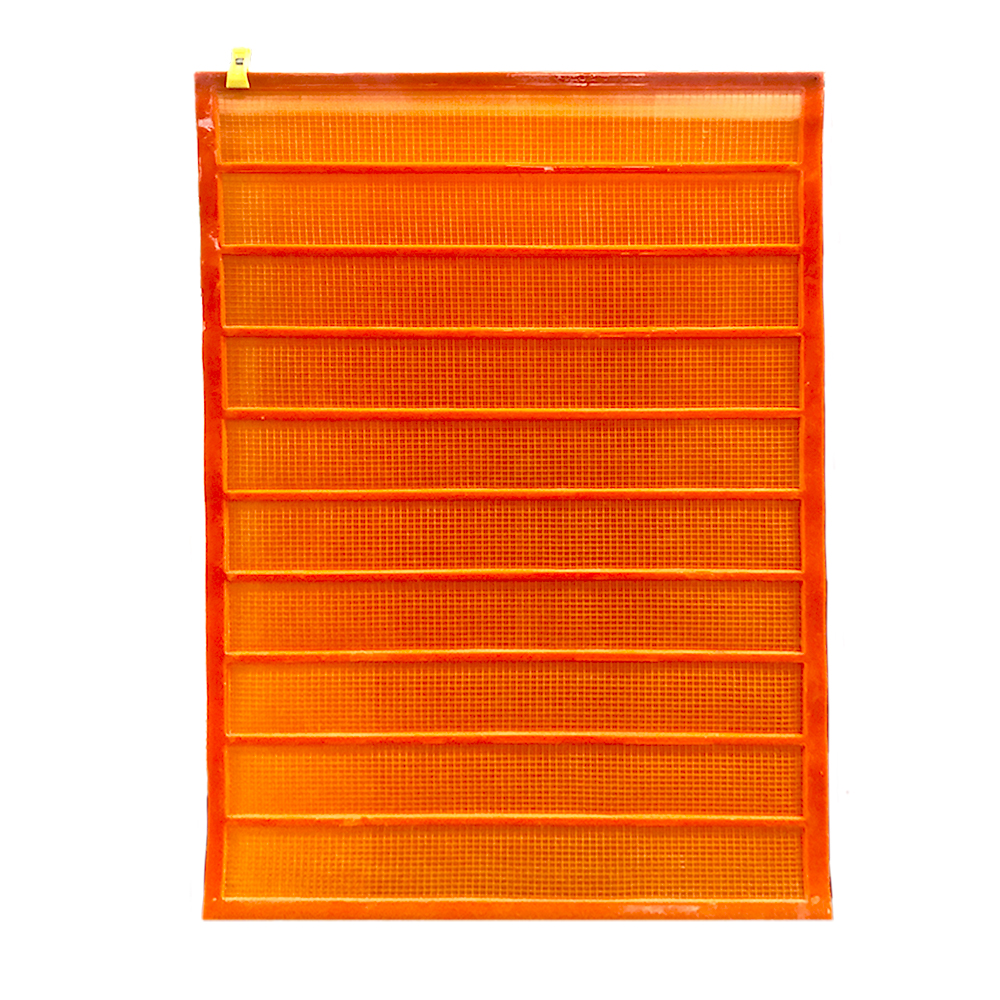
Polyurethane is a highly versatile elastomer engineered for extreme sliding abrasion resistance. In wet screening applications, panels are formulated with a durometer ranging from 80 to 95 Shore A. This specific hardness balance provides the necessary rigidity to maintain accurate aperture sizing while offering enough surface resilience to deflect abrasive slurry particles. The inherent molecular structure of polyurethane allows it to outlast traditional woven wire and many rubber compounds when subjected to continuous, high-velocity wet friction.
We rely on this specific durometer range for a reason. If the panel is too soft, it sags under the slurry weight and the apertures stretch, ruining the cut-point. If it is too hard, it becomes brittle and cracks under vibration. The 85 Shore A range hits the sweet spot. It holds its shape while absorbing the sliding friction of silica sand and crushed ore.
Not all polyurethanes are suitable for wet environments. The distinction between Ether-based and Ester-based polyurethanes is a critical engineering parameter. Ester-based polyurethanes offer excellent physical toughness but are highly susceptible to hydrolysis. Hydrolysis is a chemical reaction where water molecules break down the polymer chains, leading to rapid catastrophic failure. Ether-based polyurethanes must be specified for any wet screening media. Their chemical structure inherently resists water-induced degradation, ensuring structural stability in submerged or high-moisture conditions.
I have seen Ester panels dissolve into a sticky mess after a month in a wet circuit. The water literally unzips the polymer molecules. Ether-based compounds ignore the water entirely. They maintain their tensile strength and abrasion resistance regardless of how long they sit in the slurry. Always verify the chemical base with the manufacturer before installation.
When continuously exposed to water and chemical slurries, properly formulated polyurethane maintains its mechanical properties. It does not swell, soften, or absorb moisture. These are common failure modes in inferior elastomeric products. The material low coefficient of friction facilitates smooth material flow across the deck, preventing the buildup of sticky fines. This consistent performance ensures that the classification cut-point remains accurate throughout the operational lifespan of the panel.
The smooth surface of polyurethane is a massive advantage. Slurry glides over it. This reduces the drag on the vibratory motors and keeps the material moving toward the discharge end. We notice a significant drop in bed depth when switching from rougher media to polyurethane. The material stratifies faster, allowing the fines to find the apertures quickly.
Injection molding technology gives polyurethane a distinct manufacturing advantage. Engineers design precise, relief-tapered openings that expand downward. This downward-flaring geometry ensures that any particle passing the top surface of the aperture falls freely through the deck, virtually eliminating pegging. Injection molding allows for thinner structural webbing between apertures, maximizing the total open area of the panel without compromising its load-bearing capacity.
A straight-walled aperture is a trap for near-size particles. Once a rock wedges in, it stays there. The relief angle on a molded polyurethane panel changes everything. If a particle fits through the top, the hole gets wider as it drops. It cannot get stuck. This design keeps the open area clear and the throughput high.
The inherent flexibility of polyurethane transmits vibratory energy highly efficiently. This dynamic movement stratifies the material bed, forcing heavier, finer particles to the bottom where they contact the screen surface. The secondary high-frequency vibration generated within the polyurethane panel itself acts as a self-cleaning mechanism. It actively dislodges near-size particles and prevents blinding. This energy transmission is vital for maintaining high throughput in dense slurry applications.
You can actually see the panels working. While the main steel frame moves at a set stroke and frequency, the center of the polyurethane panel flutters. This secondary vibration is what breaks the surface tension of wet, sticky clays. It kicks the blinding material loose and keeps the apertures open. Rigid media cannot replicate this self-cleaning action.
Rubber is engineered to handle massive kinetic energy. Its superior elastic deformation capabilities allow it to absorb the heavy impact of large, coarse feed materials dropping from significant heights. When massive boulders strike a rubber screen, the material compresses and rebounds, dissipating the energy without tearing or fracturing. This makes rubber the undisputed standard for primary scalping decks where impact resistance supersedes fine classification accuracy.
In a primary crusher discharge, rocks the size of engine blocks hit the deck. Polyurethane would shatter instantly under that point load. Rubber just bounces them off. The thick rubber mats absorb the shock, protecting the steel sub-frame from cracking. We use rubber where the primary goal is protecting the equipment, not precise sizing.
Heavy-duty rubber media is rarely homogeneous. To withstand the extreme forces of primary screening, rubber panels and tensioned mats are heavily reinforced. Manufacturers embed internal steel plates, high-tensile steel cables, or synthetic cord backings within the rubber matrix. This reinforcement prevents the media from sagging under heavy material loads and maintains the structural integrity of the deck during violent vibratory strokes.
Without internal reinforcement, a rubber mat would stretch like a rubber band under the weight of the ore. The steel cables hold the tension. When we install these mats, we torque the tensioning bolts to specific limits. The internal cables take the load, keeping the rubber flat and tight across the cambered deck.
Despite its impact strength, rubber exhibits significant limitations in wet, fine-particle classification. Manufacturing constraints dictate that punched or molded rubber struggles with fine apertures. Openings smaller than 6mm to 10mm compromise the structural webbing, leading to rapid tearing. Rubber panels designed for fine screening possess excessively thick webs, which drastically reduces the overall open area. This low open area, combined with rubber higher coefficient of friction, significantly increases the risk of blinding in wet conditions.
You simply cannot punch a 1mm slot into a thick rubber mat and expect it to hold up. The webbing between the slots will tear within hours. To make it survive, you have to make the webbing so thick that you lose all your open area. A rubber panel might only have 15% open area compared to 35% for a comparable polyurethane panel. That difference kills plant throughput.
The performance of rubber in slurry depends heavily on the specific compound. Natural rubber offers excellent abrasion resistance but can be susceptible to degradation from certain chemicals or tramp oils found in process water. Synthetic rubbers like SBR or Neoprene offer different chemical resistance profiles. Many rubber compounds carry a risk of water absorption and swelling over time, which distorts aperture sizes and ruins cut-point accuracy.
We check the rubber panels for swelling during maintenance days. If the rubber absorbs water, the apertures shrink. A 10mm hole becomes an 8mm hole. Suddenly, the downstream circuit is starved of material because the screen is rejecting product it should be passing. You have to match the rubber compound to the water chemistry perfectly to avoid this.
The core of the rubber screen vs polyurethane debate centers on the primary wear mechanism. Performance curves clearly indicate that polyurethane dominates in environments characterized by sliding slurry abrasion. Its smooth surface and molecular toughness resist the scouring action of fine silica. Rubber excels under heavy drop-height impact. Polyurethane cracks or shatters under the kinetic load of massive primary feed, while rubber absorbs the blow. Engineers map the wear zone to the correct material.
We look at the feed chute to make this decision. If the material drops three meters directly onto the deck, we install rubber impact panels for the first row. Once the material is moving horizontally across the deck, we switch to polyurethane. This hybrid approach uses the strengths of both materials and eliminates their weaknesses.
Plant throughput correlates directly with the open area percentage of the screening media. Polyurethane ability to maintain structural integrity with highly tapered, fine apertures gives it a massive efficiency advantage in secondary and tertiary circuits. Polyurethane panels feature complex slot configurations, precise square apertures, or specialized teardrop shapes designed to accelerate drainage. Rubber cannot match this geometric precision at fine micron sizes, resulting in lower throughput and higher rates of misplaced material.
When we need to maximize tons per hour, open area is everything. Polyurethane allows us to pack more holes into the same square footage. The injection molding process creates incredibly thin, yet strong, webbing. We use slotted apertures aligned with the material flow to increase the open area even further, pushing maximum volume through the deck.
| Feature | Polyurethane Panels | Rubber Panels |
|---|---|---|
| Minimum Aperture Size | 0.1mm (Slotted) | 6.0mm (Punched) |
| Open Area Percentage | High (Up to 45%) | Low (Typically 15-25%) |
| Aperture Geometry | Highly Tapered, Precise | Straight Walled, Rough |
| Best Application | Fine Wet Screening | Coarse Dry Scalping |
In dewatering applications, polyurethane is the industry standard. Dewatering-specific polyurethane panel profiles utilize ultra-narrow, high-frequency slotted apertures combined with integrated water dams and weir bars. These features slow the material flow, forcing water down through the slots while creating a deep material bed that acts as its own filter medium. Traditional rubber screens lack the fine aperture capabilities and structural rigidity required for effective high-frequency dewatering.
Dewatering screens run at very high G-forces. The panels must be rigid enough to handle the stress without flexing too much. We use polyurethane panels with 0.3mm slots and built-in dams. The dams hold the sand back, building a thick cake. The vibration squeezes the water out of the cake and through the slots. Rubber simply cannot perform this function.
Mining slurries present aggressive chemical challenges. Highly acidic environments or highly alkaline conditions demand specific polymer tolerances. Ether-based polyurethane demonstrates exceptional broad-spectrum resistance to fluctuating pH levels and process chemicals. While certain synthetic rubbers can be formulated for chemical resistance, standard natural rubber degrades rapidly when exposed to specific reagents, hydrocarbons, or extreme pH shifts, leading to premature media failure.
We test the slurry pH daily. If it drops below 4.0, standard rubber is off the table. The acid eats the natural rubber binders. Ether-based polyurethane handles the acid without issue. It also resists the flotation reagents and frothers that carry over from upstream circuits. Chemical stability is just as important as mechanical strength.
Modern mineral processing prioritizes maintenance safety and efficiency. Polyurethane screen panels are predominantly modular, utilizing pin and sleeve, snap-in, or grooved step-system fastening mechanisms. These lightweight panels can be safely handled and installed by a single technician. Traditional rubber tensioned mats are bulky, exceptionally heavy, and require specialized rigging and multiple personnel to maneuver, significantly increasing maintenance downtime and safety risks.
Changing a tensioned rubber mat takes a crew of four and a crane. It takes hours. Changing a modular polyurethane panel takes one person and a mallet. It takes two minutes. When a single panel wears out in the impact zone, we just pop it out and replace it. We do not have to throw away an entire 8-foot mat just because one section is worn.
Both polyurethane and rubber offer substantial noise reduction benefits compared to traditional woven wire cloth. By absorbing the impact of falling rock and dampening the acoustic resonance of the vibrating steel frame, elastomeric media helps plants meet stringent occupational noise exposure limits. Rubber provides slightly better sound deadening for heavy, coarse impact. Polyurethane effectively mitigates the high-frequency noise generated by fast-moving slurries and aggressive vibratory strokes.
Steel wire screens scream. The metal-on-metal impact creates a deafening high-frequency noise. Switching to elastomers drops the decibel level immediately. It changes the work environment entirely. Operators can actually communicate near the screens. This noise reduction is a major factor in meeting safety regulations and improving site conditions.
Converting a vibrating screen from traditional tensioned wire or rubber mats to modular polyurethane screen panels requires careful engineering. The deck frame must be modified to accept the new fastening system. This involves removing cambered deck profiles to create a flat surface, installing new stringer rails, and securing conversion adapters. Failure to accurately align the sub-frame results in uneven panel seating, leading to localized wear and material bypass.
You cannot just drop flat panels onto a curved deck. We have to cut out the old cambered stringers and weld in flat ones. The spacing must be perfect. If a stringer is off by a few millimeters, the panels will not snap in correctly. They will sit loose, vibrate against the frame, and destroy themselves in days. Precision during the retrofit is non-negotiable.
Thermal limits dictate media selection in specific circuits. Polyurethane possesses a lower thermal tolerance than rubber, typically maxing out between 60°C and 70°C in wet applications. Exceeding this threshold causes the polyurethane to soften, lose its structural rigidity, and rapidly degrade. In high-temperature circuits, such as those processing hot slag or utilizing heated process water, specialized high-temp rubber compounds are required to prevent catastrophic media failure.
We monitor slurry temperatures closely in geothermal or heated process circuits. If the water hits 80°C, standard polyurethane turns to jelly. It loses all abrasion resistance. We have to switch to EPDM rubber or specialized high-temp polymers. Always verify the maximum operating temperature before specifying the media.
The integrity of a modular deck relies entirely on its fastening system. Improper installation creates gaps between panels. Loose pins, unseated snap-in edges, or utilizing worn polyurethane stringers are common issues. High-velocity slurry immediately exploits these gaps, causing structural damage to the steel sub-frame and allowing oversize material to bypass the screening circuit. Standardized operating procedures and rigorous post-installation inspections mitigate this risk.
A loose panel is a dead panel. The slurry finds the path of least resistance. If there is a gap, the sand washes through it, cutting the steel stringer underneath. We train the maintenance crews to strike every pin dead center and verify the panel edges are flush. We run a hand across the seams to ensure everything is locked down tight before starting the feed.
Executing a full-deck conversion without empirical data introduces significant operational risk. Plant engineers manage transition periods by running controlled trial panels. Installing a test section of polyurethane panels in high-wear impact zones or discharge lips allows operators to validate wear life, monitor throughput changes, and confirm cut-point accuracy. This data-driven approach ensures the selected polymer formulation and aperture geometry perform as expected before committing to a complete deck overhaul.
We never change an entire deck blindly. We install a row of test panels right in the middle of the flow. We measure them with calipers every week. We track the wear rate and check for pegging. Once we prove the panels work in that specific slurry, we convert the rest of the deck. It eliminates the guesswork.
The performance of polyurethane media is highly dependent on the manufacturing process. Inconsistent curing temperatures, improper mixing ratios, or poor mold designs result in substandard panels that fail prematurely. Engineers establish strict criteria for vetting manufacturers. Validation focuses on the supplier polyurethane curing processes, shore hardness consistency across batches, polymer formulation integrity, and strict dimensional tolerances for modular fitment.
Bad polyurethane looks exactly like good polyurethane until you put it in the machine. Then it fails in a week. We require suppliers to provide hardness test results for every batch. We check the dimensions of the panels when they arrive. If they are warped or out of square, we reject them. The modular system only works if the manufacturing tolerances are perfect.
While rubber remains the undisputed leader for absorbing heavy kinetic energy in primary impact zones, polyurethane screen panels stand as the definitive, evidence-backed choice for wet screening applications. The distinct advantages of Ether-based polyurethane ensure maximum classification efficiency. By eliminating pegging and blinding, polyurethane media maintains consistent open area and drives higher volumetric throughput in challenging slurry environments.
Selecting the correct media requires a rapid decision matrix based on specific circuit parameters. If the feed involves massive, dry boulders dropping from a height, specify heavy-duty rubber. If the application involves secondary or tertiary classification, high moisture content, fine particle separation, or dewatering, specify modular polyurethane. Matching the elastomeric properties to the primary wear mechanism is the foundation of an optimized screening circuit.
A: The primary difference lies in their mechanical strengths. Rubber excels at absorbing heavy kinetic impact from large, coarse materials without tearing. Polyurethane offers superior resistance to sliding abrasion, allows for much finer aperture sizing, and provides a higher open area, making it ideal for fine classification.
A: Polyurethane, specifically Ether-based formulations, resists hydrolysis and water-induced degradation. Its injection-molded, highly tapered apertures prevent pegging and blinding, while its smooth surface handles fine slurry abrasion exceptionally well, ensuring consistent drainage and accurate cut-points.
A: Yes. A highly effective strategy is installing heavy-duty rubber panels at the feed end to absorb the initial kinetic impact of the material, and utilizing polyurethane panels for the remainder of the deck to optimize fine classification and maximize dewatering efficiency.
A: Polyurethane prevents pegging through relief-angled, downward-flaring apertures that allow near-size particles to pass freely. Additionally, the material inherent flexibility transmits high-frequency vibrations that actively dislodge sticky fines, preventing blinding across the deck surface.
A: Process water containing chemical additives, acids, or tramp oils can rapidly degrade standard natural rubber compounds. Ether-based polyurethanes offer superior broad-spectrum resistance to fluctuating pH levels and water-induced breakdown, ensuring longevity in aggressive chemical slurries.
A: Transitioning from traditional tensioned wire or rubber mats to modular polyurethane panels usually requires modifying the deck. This involves flattening the cambered frame and installing specialized adapter rails, polyurethane stringers, and pin/leg or grooved fastening systems to secure the modular panels.
A: Lifespan varies based on feed abrasiveness, tonnage, and slurry chemistry. However, when properly specified and installed in wet, sliding-abrasion environments, polyurethane screen panels routinely outlast traditional woven wire and standard rubber media by a significant margin, reducing maintenance frequency.


