

Views: 0 Author: Site Editor Publish Time: 2026-07-13 Origin: Site


Fugitive material and carryback create massive financial and operational burdens in high-capacity mining environments. When thousands of tons of raw ore move across a site daily, even a fraction of a percent clinging to the return side of the belt results in tons of destructive accumulation. This unmitigated buildup transforms conveyor systems into the primary bottleneck of mine production. It leads directly to premature component failure, unplanned downtime, and heavy maintenance overhead that drains site profitability.
To protect capital equipment and stabilize throughput, operations must deploy specialized defense mechanisms at the discharge zone. A properly engineered mining belt cleaner serves as the frontline safeguard against equipment degradation. By actively shearing away residual ore before it can foul the return run, these systems ensure operational safety and maximize conveyor availability. You cannot run a high-tonnage facility efficiently without controlling what stays on the belt after the head pulley.
Fugitive material aggressively attacks the rotating components of a conveyor system. When carryback dislodges along the return run, it encapsulates rollers and infiltrates bearing seals. This contamination leads to immediate bearing seizure and drastically increased rotational resistance. The friction generated by a seized roller can rapidly wear through the steel roller shell, creating razor-sharp edges that slice into the conveyor belt cover. In a matter of weeks, a single seized return idler can destroy thousands of dollars worth of belting.
The impact of carryback varies depending on the materials used in the conveyor structure. Advanced lightweight composite rollers offer some resistance to material adhesion, but they still suffer when bearings are compromised by fine, abrasive dust like silica or iron ore. Traditional steel idlers are particularly vulnerable to abrasive degradation. Furthermore, trapped particulates grind against pulley lagging, stripping away the protective rubber or ceramic layers. This degradation causes anti-slip pulleys to fail, resulting in severe belt slippage, loss of drive traction, and eventual belt burn-through at the drive pulley.
Uneven material buildup on tail pulleys, drive pulleys, and return idlers fundamentally alters the physics of the conveyor system. As carryback accumulates irregularly across the face of a pulley, it creates an artificial crown. This uneven diameter forces the belt to wander off its intended centerline, seeking the point of highest tension. You will often see belts tracking hard to one side simply because a return roller has a half-inch buildup of hardened mud on one end.
The cascading effects of belt wander are highly destructive. Severe edge damage occurs as the belt grinds against the conveyor frame, tearing the rubber and exposing the internal fabric or steel cords to moisture. Structural friction generates excessive heat, creating a severe fire hazard in enclosed environments. Additionally, a misaligned belt causes massive spillages that bypass primary collection points, burying walkways, covering drive motors, and creating hazardous working conditions that require manual shoveling to clear.
Carryback adds dead weight to the conveyor system. Every ton of fugitive material clinging to the belt requires energy to move. When combined with the increased drag from seized roller bearings and friction from misaligned belts rubbing against the frame, the system experiences a massive spike in operational resistance. The drive system has to work significantly harder just to maintain empty belt speeds.
This continuous resistance places unnecessary electrical load and thermal stress on drive motors. Motors are forced to draw higher amperage to maintain belt speed, leading to overheating and premature stator failure. Quantifying this energy loss often reveals that running a dirty belt consumes up to 15% more electricity than a clean, optimized system. Over a year of continuous operation, that wasted energy translates into massive utility costs and shortened motor lifespans.
Effective material control requires a multi-stage approach. The primary cleaner is installed at the head pulley, positioned just below the material trajectory. Its function is to shear off the bulk of cohesive material before the belt leaves the discharge zone. This initial pass removes up to 90% of the carryback, handling the heavy, wet, or sticky ore that refuses to discharge naturally.
A secondary cleaner is installed further down the return side, typically where the belt leaves the head pulley and becomes flat. This unit focuses on fine particulate removal and moisture control, scraping away the sticky residue that bypasses the primary blade. Tertiary cleaners, such as V-plows and diagonal plows, are installed just before the tail pulley. They deflect gravity-fall debris, preventing rocks from becoming trapped between the belt and the pulley, which would otherwise punch holes directly through the belt carcass.
| Cleaner Type | Installation Location | Primary Function | Target Material |
|---|---|---|---|
| Primary Scraper | Face of the head pulley (3 o'clock position) | Bulk material removal | Heavy, cohesive ore and large debris |
| Secondary Scraper | Return run, just past head pulley | Fine particulate cleaning | Sticky fines, dust, and moisture |
| V-Plow / Diagonal Plow | Return run, immediately before tail pulley | Tail pulley protection | Gravity-fall rocks and fugitive lumps |
| Wash Box System | Return run, after secondary scraper | Final polishing and dust mitigation | Extreme mud and microscopic fines |
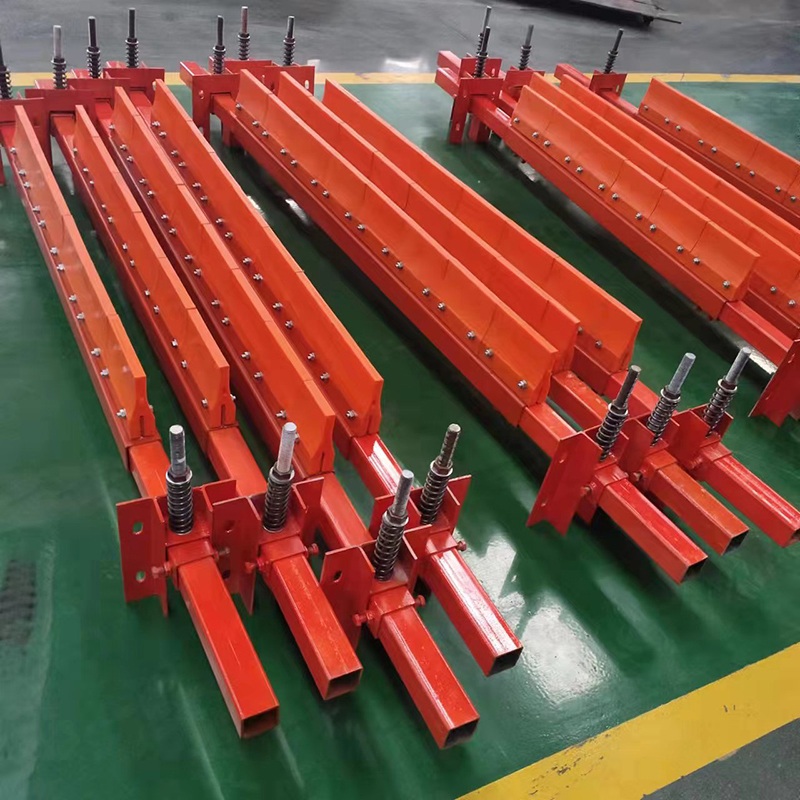
The formulation of the scraper blade dictates its effectiveness and safety. A polyurethane belt cleaner offers distinct advantages due to its high abrasion resistance, flexibility, and low friction coefficient. Polyurethane conforms to the belt profile, ensuring consistent contact without gouging the rubber cover. Manufacturers cast these blades in various durometers (hardness levels) to match specific environmental conditions, from soft, wet clay to hard, jagged granite.
When comparing polyurethane against metal alloys like tungsten carbide, belt safety is the primary concern. Tungsten carbide provides exceptional wear life for high-speed, vulcanized belts handling abrasive fines. However, carbide blades can catch and rip mechanical splices. Polyurethane is the safer choice for mechanically spliced belts and high-tensile designs, as the flexible material yields to metal fasteners while maintaining cleaning pressure. It absorbs the impact of the splice and immediately rebounds to clean the belt.
A scraper blade is only effective if it maintains optimal contact with the belt. Constant-pressure tensioners, utilizing springs, air, or nitrogen cylinders, automatically adjust the blade position as the urethane wears down. This dynamic tensioning ensures the cleaning edge remains flush against the belt surface, compensating for the inevitable loss of blade volume over time.
Proper tensioning prevents blade chatter, a rapid bouncing effect that leaves material behind and causes micro-impacts on the belt cover. By maintaining smooth, continuous pressure, dynamic tensioners maximize blade life and protect the structural integrity of the conveyor belt. If a tensioner locks up or loses pressure, the blade drops away from the belt, and carryback immediately floods the return run.
Underground coal operations face strict regulatory and safety challenges. Equipment must meet stringent certifications to prevent explosive hazards. Cleaners used in these environments require flame-retardant and anti-static (FRAS) polyurethane formulations to eliminate the risk of static discharge or frictional ignition. The frames and tensioners must also be designed to operate in highly confined spaces where maintenance access is severely limited.
Surface quarries operate under entirely different constraints. Open-pit environments expose conveyors to extreme temperature fluctuations, heavy airborne dust, and massive volume variations due to rain or snow. Cleaners in quarries must feature rugged, corrosion-resistant frames and heavy-duty blades capable of handling frozen material and abrasive rock dust. UV degradation is also a factor, requiring UV-stabilized urethane blends for outdoor installations.
The physical characteristics of the conveyed material dictate the scraper design. Sticky clay requires aggressive blade angles to peel the material away from the belt, often utilizing a peeling action rather than a scraping action. Abrasive iron ore demands high-volume polyurethane formulations to resist rapid wear and frequent replacements. Wet coal often requires a combination of primary and secondary scrapers to manage both bulk and moisture effectively.
When dry scraping is insufficient for highly cohesive fines, specialized wash boxes and water-spray systems become necessary. These systems apply a fine mist to soften hardened carryback, allowing the secondary scrapers to squeegee the belt clean. This approach is highly effective for managing extreme mud and sticky slurry, though it requires a reliable water supply and a method for managing the resulting effluent at the discharge point.
Matching cleaner specifications to the conveyor system is critical for success. High-speed, high-capacity mining belts generate immense kinetic energy. A system must feature heavy-duty mounting poles and reinforced blades to withstand the continuous impact of heavy ore. If you put a light-duty scraper on a 6 m/s belt carrying copper ore, the blade will fold over or the shaft will snap within hours.
Wide belts require significant structural rigidity. If the scraper shaft is too weak, the center of the blade will bow away from the belt under pressure. This center-bowing allows material to pass directly down the middle of the return run. Engineered systems utilize oversized, thick-walled steel tubing to ensure uniform blade contact across the entire belt width, preventing the "smile effect" where only the edges of the belt get cleaned.
The type of belt splice heavily influences scraper selection. Aggressive scrapers pose a severe risk to mechanically spliced belts. If a rigid blade catches a raised metal fastener, it can rip the splice entirely, causing catastrophic belt failure and days of downtime.
To prevent splice ripping, cleaning systems must incorporate relief mechanisms. Shock-absorbing mountings allow the blade to deflect downward momentarily when a mechanical splice passes. Alternatively, specific blade angles can be utilized so the scraper glides over the fasteners rather than catching their leading edges. Vulcanized splices, being smooth and continuous, allow for the use of rigid tungsten carbide blades without risk of impact damage.
A cleaning system does not operate in isolation. Its design must align with other conveyor components to ensure holistic reliability. For example, the placement of secondary scrapers must not interfere with advanced tracking systems installed on the return run. If a scraper dumps wet fines directly onto a return idler, it defeats the purpose of the cleaner.
Furthermore, impact beds and cradles at loading zones must stabilize the belt to prevent bouncing. If the belt bounces excessively at the head pulley due to poor loading conditions upstream, the primary cleaner will lose contact, allowing carryback to escape. Ensuring a stable belt path is essential for maximizing the efficiency of the cleaning equipment.
A common but dangerous assumption in conveyor maintenance is that higher tension equals better cleaning. Applying excessive force to a scraper blade does not improve material removal; it actively damages the system. Maintenance crews often crank up the tensioners when a blade starts leaving material behind, rather than investigating why the blade is failing.
The consequences of over-tensioning are severe. It causes accelerated blade wear, forcing premature replacements. The extreme friction generates excessive heat, which can melt polyurethane blades or damage the belt cover. Furthermore, over-tensioning increases belt drag, forcing the drive motor to consume more power to overcome the artificial resistance. Proper tensioning requires following the manufacturer's exact torque or pressure specifications.
Retrofitting cleaners into existing, confined discharge chutes presents significant physical limitations. Many older conveyor systems were not designed with adequate clearance for modern, multi-stage cleaning systems. Maintenance teams often struggle to find proper mounting locations that allow for safe access and proper blade angles.
Proper material trajectory planning is necessary to prevent the cleaner assembly itself from becoming a catch-point for material build-up. If the scraper is installed too far back in the chute, the removed carryback will pile up on the mounting pole, eventually burying the cleaner and rendering it useless. The chute must be modified to ensure scraped material falls freely into the discharge flow, often requiring custom deflector plates.
Evaluating the cost of a cleaning system requires looking beyond the initial purchase price. Budget scrapers often feature flimsy frames and low-quality urethane, requiring constant adjustment and frequent blade replacements. Buying cheap scrapers guarantees you will spend more on labor and replacement parts over the life of the conveyor.
Engineered, application-specific systems require a higher initial capital expenditure but deliver substantial long-term value. When calculating the return on investment, operations must factor in the reduced labor costs of manual cleanup, the elimination of premature pulley lagging wear, and the drastic reduction in unplanned conveyor downtime. A premium cleaner pays for itself the first time it prevents a belt tear.
Reliability depends on consistent, structured maintenance. Operations should implement a daily visual checklist to monitor carryback levels under the head pulley. Technicians must verify tensioner settings, check blade wear limits against the manufacturer's indicators, and clear any material buildup on the main frame.
These inspections must integrate with broader conveyor checks. Evaluating the condition of anti-slip pulley lagging, monitoring roller bearing temperatures, and verifying belt tracking status will often reveal whether the cleaning system is functioning correctly or if carryback is beginning to bypass the blades.
Maintenance tasks in discharge chutes are inherently hazardous. To minimize downtime and reduce confined space entry, modern cleaning systems utilize slide-out, cartridge-style, or track-mounted designs. Implementing a safe replacement protocol involves specific steps:
These engineered solutions allow technicians to pull the entire blade assembly out the side of the chute. The blade can be replaced safely on the walkway, and the cartridge slides back into place. This protocol eliminates the need for technicians to reach into the hazardous zone beneath the head pulley, drastically improving site safety.
The mining industry is transitioning from reactive to predictive maintenance through the adoption of smart systems. Smart tensioners automatically adjust blade pressure and transmit data regarding blade wear and tension levels to a central control room. This eliminates the guesswork from maintenance scheduling.
Remote blade-wear sensors alert maintenance teams exactly when a replacement is needed, preventing the blade from wearing down to the metal core. This digital monitoring reduces physical inspection frequency in hazardous mining zones, optimizing labor deployment and ensuring the conveyor remains protected at all times.
A: A primary scraper is installed on the face of the head pulley to shear off the heavy, bulk material. A secondary scraper is mounted further back on the flat return run to squeegee away fine particulates and sticky moisture that bypass the primary blade.
A: Replacement frequency depends on belt speed, tonnage, and material abrasiveness. Blades must be replaced when they wear down to the manufacturer's indicator line or when the tensioning system runs out of travel distance.
A: Yes, if improperly specified or maintained. Over-tensioning causes extreme friction and cover wear. Using rigid metal blades on mechanically spliced belts can catch the fasteners and rip the splice apart.
A: By scraping the belt clean at the discharge point, the system prevents fine dust and abrasive particles from dropping onto the return run. This keeps contaminants away from bearing seals, preventing roller seizure and shell wear.
A: Yes. Underground coal mines require equipment with fire-resistant and anti-static (FRAS) certifications to prevent frictional ignition and static discharge. Systems must also be designed for safe maintenance in highly confined spaces.
A: Spring tensioners are reliable and easy to maintain visually. Air tensioners provide precise, constant pressure but require a reliable pneumatic supply. Torsion tensioners are excellent for confined spaces where external mounting room is limited.
A: They serve different purposes. Tungsten carbide offers superior wear life for high-speed, vulcanized belts handling abrasive fines. Polyurethane is required for mechanically spliced belts, wet/sticky ores, and heavy bulk removal at the primary position.


